Credit Sequence
Well, I’ve done this twice before, and I think it’s officially becoming a trend. That is, in so much as if I’m going to keep contributing financially to fly-by-night DVD releases so that my name ends up in the credits, there will eventually be a string of these on the blog. Until I get my own IMDB page, at which point tooting my own horn in this fashion will become slightly redundant.
This year’s DVD credit comes from the bizarre fan-film Benjamin Sniddlegrass and the Cauldron of Penguins. Unlike most of the fan films of the nerd spectrum, from Troops to Browncoats: Redemption, this is based not based on a film, but on a film review. BBC film reviewer Mark Kermode said, whilst castigating Percy Jackson and the Lightning Thief, that the plot was such an identikit punchcard knock-off of Harry Potter that it might as well be called “Benjamin Sniddlegrass and the Cauldron of Penguins”. This made me laugh uproariously, and I did what most people do when they find something delirious: I made the comment into my Facebook status for the moment.
But Jeremy Dylan wasn’t most people, and instead of just parroting someone else’s punchline, he took it and ran with it. Read the rest of this entry »
Alternate Musical Reference: Better Know How To Kneel
My favorite place for pop-culture watching, New York magazine’s The Vulture, recently posted two “clickables”. The first was a Dreamworks-produced video for the song by the frontman for Sigur Ros that accompanied their thoroughly-enjoyable summer trifle, How to Train your Dragon. Now that the song is going to be on the Academy Award shortlist longlist, it seems that someone thought it would be a good idea to give the tune a little viral push, many months after the film graced screens and some months even after the film arrived on home video. They make it seem like it was just something the boys at the studio slapped together, but that’s part of the myth of viral videos, much like all successful computer companies “started in a garage“.
Regardless of it’s origins, watching it in close proximity to a young man’s Pixar tribute made me re-notice the trope of a character engaging in a little celestial wonder by reaching up to touch a piece of the sky, something I’d seen before.
Now, I’ve just spent an hour on TV Tropes trying to see if anyone else has categorized this particular visual theme, and aside from a stray comment that the flying sequence in Dragon echoes the magic carpet ride from Disney’s Aladdin, I didn’t find it. Now, that may be because TV Tropes loves cutesy referential names for their tropes, and I’m simply too obtuse to crack their codes, but it doesn’t seem to be in either the How to Train Your Dragon page, or the list of Hand-based tropes. I present to you the four I was able to find in my brain and video collection, and I hope to hear of many more. If it is a fully-fledged trope, may I nominate, “‘Scuse Me, While I Touch the Sky” at it’s cutesy name?

Expert Ease
I listened to Roy Smiles’ play Pythonesque on BBC Listen Again a number of weeks back, and I just couldn’t stomach it. It wasn’t just the uncomfortable dissonance between the voices of the members of Monty Python’s Flying Circus that live in my aural memory and the impressions that were being done for the Radio 4 performance. No, I’d like to think that I can give actors a pass for not totally resembling a real-life person, and when I caught both Eric Idle’s Greedy Bastard Tour many years ago and the more recent An Evening Without Monty Python I found that listening to other people do the lines of established skits didn’t bother me. Their timing, on occasion, sure — the same way that any cover or live version of a song can mess with your internal metronome — but not the voices.
What I believe it reminded me of, more than anything, was my still-smoldering hatred for The Tao of Pooh, which remains, yea these seventeen years after I read it for philosophy class and threw it across my living room in a clichéd but honest fit of pure revulsion, my least favorite text in the English language, beating out the writings of both Dan Brown and Akiva Goldsman. The conversations in Pythonesque were staged in such a way that they felt robotic, both in that they were constructed in ways in which no people had ever talked to one another, and also in that they were jammed full of little notes and lines and references from the show and from the films. This was an attempt to win the audience over, to show that the writer knew the subject matter and to warm the cockles of our nostalgia. Instead, it made it feel to me like a Frankensteinian patchwork of words enjambed together in unnatural ways, with the halting, twitchy cadence of Werner Brandes’ security lapse.
Soon thereafter I had a chance to listen to Good Evening a play featuring a pre-Sherlock Benedict Cumberbatch as Dudley Moore and three other actors as his comedic contemporaries. Despite having heard most of their names, I have never plumbed the depths of the work of Peter Cook, Moore, and the like; they are regularly namechecked as comedy establishment luminaries, but my instinct has always been that since I was so much a fan of the madcap subversion — by those like the Python troupe — that came after, that I might find them clever… but a little staid. However, I was enjoying the radio play, and it wasn’t until about three-quarters of the way through that I was suddenly struck by the suspicion that it was by the same author. I was running around in my head how interesting it was that the comedian characters were expressing their personal problems in the style of the style of the sketches they had written when the link suddenly became clear. But while Smiles’ Good Evening pulled this off, it was because it employed structure as artifice. There would be scenes of the characters together, as people, and then it would switch into a sketch narrative that served to illustrate the issues mentioned previously, with the characters playing the roles they’d made famous, but with a heaping dollop of subtext. The Guardian theatre critic says that Pythonesque was written “‘in the style of’ the troupe’s comedy”, which seems to translate into Smiles having the characters constantly whooping, chirping, and dropping references as if they never stopped inhabiting their roles from the television series. And while this might service the fantasies of some Python superfans, it simply doesn’t ring true.
It seems Smiles goes to this well with some regularity… back in 2004 a play of his was produced called Ying Tong that featured the character of Spike Milligan and the various characters he’d played in The Goon Show, with the characters existing within the drama as manifestations of Milligan’s real-life bouts with mental illness. But again, the dramatic conceit here gives license to giving the fans the characters they loved while maintaining the humanity of the actual people behind them. I probably wouldn’t have minded Ying Tong, much in the same way I didn’t mind Good Evening. But my familiarity with The Goons is close to that of my familiarity with Python. I hope to see or hear Smiles’ Milligan play some day, as it might give me better insight as to whether my dislike for Pythonesque is born out of my proximity to the subject matter, or my analysis that while in his other works he constructs theatrical devices to allow for writers and their fictions to coexist.

BRIEFLY: Toastmaster General
If I were still using the “melbatoast” domain name and web-handle, I would have loved these photos from Paul Cornell‘s blog entry about the seeing geek chic fliers for local “virtual eatery” the House of Toast at CONvergence. And if that doesn’t mean anything to you at all, don’t worry, just enjoy this:
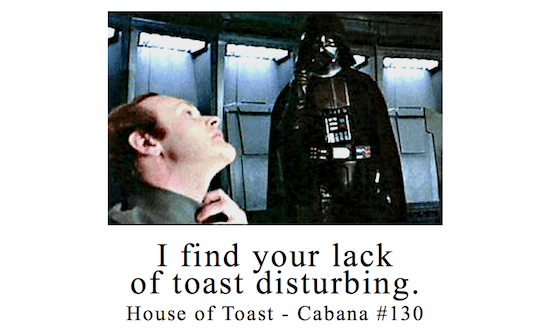
I know some of you quite enjoyed the mild confusion you felt about why I’d chosen “melbatoast” (or even “m3lbatoast”) as my online identity, and some of you haven’t successfully transitioned from the old page to this one (especially since I just killed it with nary a transitional announcement). In any case, I hope you haven’t found your lack of toast disturbing.
MEME: Business Card Gallery
One of the great things about the web is the depth to which people will go to catalogue and display seemingly trivial data. To the average person, such websites are neat, but clear evidence that the provider has no life, or has too much time on his hands, etc. I think it’s a pity that these efforts are trivialized in this manner. Inspiration is momentary, and the hard, dedicated slog from idea to fully-fledged execution takes time and commitment (q.v., again, Patton Oswalt’s insightful and vulgar commentary about Death Bed: The Bed That Eats People). It’s easy to look at a finished product and airily dismiss it as a waste of time, but it’s an accomplishment to be in the midst of that use of time and not throw up one’s hands and abandon the project in process once the initial glimmer of the idea has cooled to a faint grey ash.
One of my favorite instances of dedication to the seemingly trivial is Steven Hill’s Movie Title Screens page, wherein he takes screencaps of the appearance of the title in the film itself. Not to be swayed from his own parallel inspiration, Christian Annyas takes caps of the title image, any instance of a “The End” or “Fin” screen, as well as the title logo from trailers of a given film (which, due to marketing, are frequently different than the title within the film itself). And, yes, he has capped Charade. Is it terrible that either of these men has devoted so many hours of time to this project? Particularly when someone is doing essentially the same thing? Not to be hyperbolic, but that seems a little like saying that Samuel Johnson was an idiot, and Noah Webster and James Murray were compounded morons. Who had no lives.
Just to avoid misinterpretation of the above rhetorical: no, it’s not terrible. Reference is a wonderful thing, and it requires meticulous, sustained effort. I realize that I’m a librarian, and therefore biased, but — in a nutshell — it’s only trivial and dismissable if you don’t find it useful. If you do think it’s the most useful thing since a breadknife, then you’re surely not going to say about IMDB or Google or the phone book, etc., that whoever compiled those data had too much time on their collective hands.
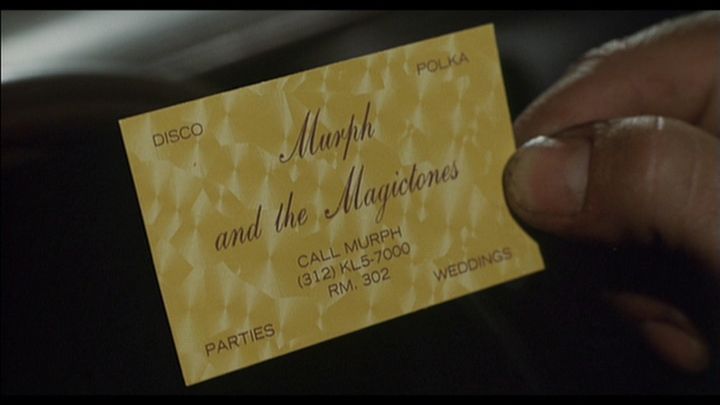
None of which probably justifies my own nascent Steven Hill-inspired collection of screencaps. I forget what I was watching, but it occurred to me that practically every shot of a business card in a film is the same shot. They’re probably all second-unit insert shots using a hand double. They’re almost always at a slight tilt, in order to give the card some substance and not to have it rigidly framed by the shape of the film itself (interestingly enough, even Wes Anderson follows this and doesn’t apply his typical hyper-formal use of symmetry). So I started collecting them, just to see how pervasive this was. I figured once I got fifty or so, I’d compile a list and send it out for further contributions, and once I got a hundred, I’d start my own useless, whimsical reference website.
In the interim, though, I tripped over The Dancing Image‘s gallery meme, as mentioned by Glenn Kenny. I like it when Glenn posts a meme contribution, because he doesn’t tag people, he doesn’t forward on the chain letter. I don’t either, mostly because I don’t have any readers, but also because I don’t like the imposition. Be inspired to contribute, or don’t be. In honor of the meme, I present my meagre collection of Business Cards in Cinema:
TV on Stage
 The-Man-who-isn’t-my-Father (that would all be one word in German) once saw Alan Rickman and Juliet Stevenson perform Shakespeare live. Considering that I’ve pretty much wanted to be Alan Rickman since I saw Robin Hood: Prince of Theives — not the film’s desired intent, I know, but there you are — and subsequently sought out and fell in love with Truly, Madly, Deeply, his experience is, in my eyes, perhaps the highest heights that one could aspire to have had. Since then, I have acquired a list of celebrity live performances that have vainly attempted to equal his. I probably would have, too, if I’d managed to see Kevin Kline in Cyrano de Bergerac on Broadway, but I will instead have to content myself by having attended live performances and readings by John Cleese, Michael Palin, Terry Jones, Eric Idle, Neil Innes, Mia Kirschner, Sally Kellerman, Michael Murphy, Elliott Gould, Suzanne Cryer, Joss Whedon, Patton Oswalt, Matt Groening, David Silverman, James L. Brooks, Anthony Daniels, and Jack Fucking Bristow, aka Victor Garber. </klang> (PS: This list to potentially include Christopher Lloyd in the near future.)
Yes, yes… I am celebrity-fawning scum (and that list doesn’t even include any literary Klangs). Or, at least, I previously have been. There’s been an arc to this process of acquisition of names worth dropping: I’ve gone from feverish and nervous of what to say, jittery and apprehensive, to vaguely dissatisfied and even irritable at the possibility of meeting someone well-known. It should come as no surprise to anyone that professional famous people don’t really give much of themselves to the people they meet at such events, particularly if they are well-heeled celebrities that have dealt with the peculiar imbalance of strangers feeling and believing that they know you because of how you’ve presented yourself on camera. At signings and receptions, they have greeted me and others with genuine, polite happiness for our appreciation of their works, undercut with equally sincere wariness. Any dissatisfaction I have felt after these events has always stemmed from a mild sourness at feeling I haven’t seen these people at their most honest; and it has absolutely been intertwined with a petty grumpiness that I wasn’t somehow special enough, intriguing enough to cut through the adverse circumstances and make an individual connection. (EDIT: For an alternate take, check out Glenn Kenny’s musings on celebrities and the clash of their private and public personae.)
Many, manymany people want their fifteen minutes of fame, and crave time in the spotlight. Whereas I find myself instead more partial to the fantasy espoused by Rob (and his mates in the film version) in High Fidelity:
“All my life I have wanted to go to bed with — no, have a relationship with — a musician: I’d want her to write songs at home, and ask me what I thought of them, and maybe include one of our private jokes in the lyrics, and thank me in the sleeve notes, maybe even include a picture of me on the inside cover, in the background somewhere…”
And not encountering that spark that would allow me to find that intimacy (the relationship part, not the first bit) whilst encountering famous people has caused me to take a step back and reevaluate why I was chasing celebrities in the first place. Thus I complete my story arc and resolve down to the more realistic expectation that I can simply be glad of whatever joy the moment or the person has brought me — from dissatisfied to at peace. And perhaps, one day, to finally one-up my not-my-father by seeing someone really impressive.
It’s not much, but it keeps me from stalking people on Twitter.
Read the rest of this entry »
A Clever Ruse
Un/Stage, a visual art and design website, has posted a list of what they consider to be the best “50+ Examples of Criterion Box Art“. “50+” apparently translates into “58” when someone actually counts, all of which I find a little odd. Lists, especially online lists, are not designed to be inclusive. They’re designed to do two things: first, to declare with grim (but anticlimactic) finality that The List Maker is an expert, an expert with the discerning taste to decide what stays on the list, and what is cast aside and kicked to the curb. Making lists, as anyone who’s tried to get into a fictional club in a film or television show knows, is about making those who are on the list feel more valuable at the expense of the egos of those left standing in line outside, imprisoned by the flimsy confines of a velvet rope and a bouncer’s level stare. It’s the special meteorological sparkle of having a rising tide lift just a few boats, and leaving the rest in a kelpy ebb.
The second purpose of a list is to generate chatter, which is why websites love them, and why any perceived expert finality is never the last word. By excluding things, you bring the commenters out of the woodwork, clawing at their keyboards and griping, “You’ve left out My Favorite, you swine, which clearly deserves inclusion, much more than your pathetic examples!” Now, perhaps a more charitable person who doesn’t have the “No Really, Shut Up” Greasemonkey script installed on his browser (Thank you, Chris Lamb) might say that such commenters aren’t purely motivated by bile. That instead, with a population of young writers in the midst of overwhelming media diversity, these commenters are helping to shed light on forgotten or niche corners of cult fandom that might have escaped the experience of The List Maker. It’s not a bad point, except that, well, I tend to think that the niche corners of the internet are populated by — as Victoria Coren reminds us — the sort of people who have a desperate fetish to be eaten by someone else, and I really don’t want to hear from them which whatevers really should have been kept on a given list.
But inspiring people to feel left behind in the velvet cordon, unworthy and sidelined, remains a good way to get them to comment, and comment breeds comment. Because the engine of the internet is not so much porn, as it is rage. Rage, rage against perceived slants against my values and the value of my individuality! Internet lists are written to engender such things; as the Criterion Current newsletter put it, “Whatever way you get your clicks”. Nyuck, nyuck, etc.
So. If any of that is true, what’s odd about the Un/Stage list is that it’s too inclusive. It can’t even keep it’s list down to fifty examples, and has to let it bleed out into a flabby fifty-eight. What seems to be the obvious implication here is that Criterion are such wonderful designers that it’s simply impossible to whittle the list down to a mere fifty examples. That only fifty wouldn’t show the breadth and depth of their aesthetic.
Whereas I return to the first criterion (unintentional pun, I swear) of list-making: if you’re not putting limits on what is In and what Isn’t, then you’re not sufficiently or successfully establishing your tastes or rubrics. And it becomes such a fluffy, inclusive exercise that it becomes difficult to see why you excludes some of them at all. Why not just post a link to the Criterion Collection website, Un/Stage? Your selection of cover art is broad enough that I can say, “Yeah, there’s some good work there,” but not be moved in any way by it (note: clearly a lie, or else why am I typing all this drivel? Read on…). This is why Top Ten lists are good, and that the Top 5 discussions in Nick Hornby’s High Fidelity are even better. They give the reader/listener/observer a clear indication of core taste, of core qualifications.
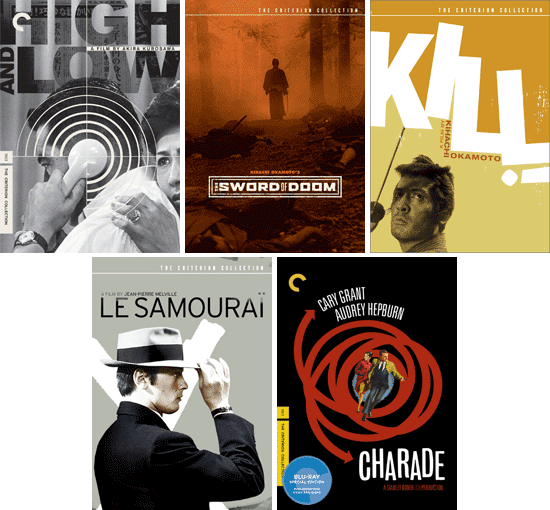
So, I present to you my Top 5 current Criterion Collection cover art. And all of the preceding waffle may or may not be a vast smokescreen to conceal my unbridled excitement that Charade is being re-re-released by Criterion, this time on Blu-Ray disc. I get to buy Charade again! I’m so pleased.
Workplace Final Fantasy
It’s been heavily blogged and retweeted that a woman has filed a wrongful termination suit claiming that she was fired from her bank job for being too hot.
That’s her and her lawyer’s wording, her colleagues are summarized as saying that “her appearance was too distracting.” I put it to you that her appearance was distracting not because of some overwhelming attraction, but because it’s hard to concentrate whilst working alongside a CGI person; you would always be looking for flaws, for pixelation, and finding yourself staring into the abyss of the Uncanny Valley, and finding it staring back into you.
As to my proof that Ms. Lorenzana is an unreal, computer-generated hologram, I offer the following photographic evidence: she is clearly an upgraded version of Dr. Aki Ross from Final Fantasy: The Spirits Within, who was similarly described by the New York Times headline writers as “Perfect” and “Gorgeous”. Please consider the following to be Exhibit A.

Ess-Words
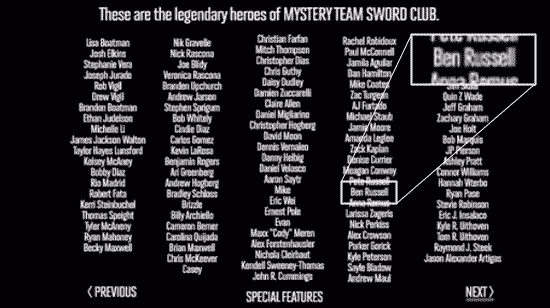
Yeah, that’s right. I am once again in the credits of a DVD. And not like those namby-pamby OneRing.net people who got to be in the credits of a DVD that people actually watched, nosiree… I’m on the credits of a DVD whose primary fans are used to getting their content via YouTube, and are more likely to torrent this than buy it. And with the demise of the video store, there’s increasingly little likelihood of this video sitting in it’s minuscule niche on a shelf next to a hundred copies of The Tooth Fairy, hoping against hope it gets noticed. But now? Now, one hopes that Donald Glover does well enough on Community and Ellie Kemper does similarly swimmingly on The Office so that their profiles are linked to Mystery Team‘s NetFlix credits, and people take a risk. Or that everything else has been checked out of the RedBox, and someone takes pity on it, like an orange-ish tuna sandwich at an automat, or one last Zagnut bar in the creaky vending machine at the auto mechanic.
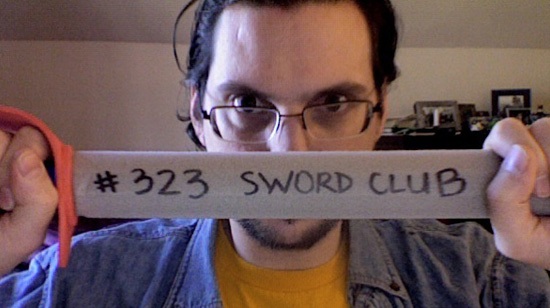
But I don’t really care about that. I’m in Sword Club, boy-ee! Bring it!
 RSS feed
 smartovercoat.com
