T-Shirts I have Worn This Summer
T-Shirts I have Worn This Summer
That Have Induced Comment By My Students
 |
 |
 |
 |
 |
 |
Sophomore Albums
Second Albums. Why are they so difficult? What, precisely, is the hurdle that makes so many reviewers refer to an artist’s “sophomore effort” in tones most frequently encountered in an oncology ward? Perhaps we expect one-hit wonders, or perhaps we are sufficiently aware of the tumultuous marketing of music, and therefore know that studios may have already abandoned their recording artists by the time the second release hits shelves. Why continue to support and help an artist mine the depths of creativity when one can move on to the Next Big Thing, the Bigger, Better Deal?
Or perhaps it’s simply novelty. A new record by a new artist is something one has never heard before. The balance of sound and words, or rhythm and melody, the particular tenor of a person’s voice are all new and therefore interesting. If the music hooks one, in a particular aspect or in a combination, then one tends to investigate the entire album closely, obsessing over and absorbing the minutiae. And the unfamiliarity is half the attraction, the novelty is key.
 So a second album has a difficult hurdle: it must still be novel, but it must also capture the elements that made the first album appealing. So it must be the same only different. And that is a teetering totter that is difficult to straddle.
Now, I rather enjoyed Norah Jones’ first album, COME AWAY WITH ME, despite my childish inability to listen to the radio single without sniggering lasciviously (“That’s alright, dear… it happens to everyone and is nothing to be embarrassed about.”). And I knew that she was going to be in a tough spot with a second album: would she continue to push Blue Note into the mainstream? Would she slip from torch songs into the slimy ooze of light jazz? Would she move the opposite direction and sidestep into a more produced pop sound? How could she maintain her established tone and sound and not be charged with the crime of not having moved, grown, or progressed? Her second album is described as tinged with a Country & Western sound, complete with guest-vocals by Dolly Parton. But, as The Guardian rightfully sums up (after some needless but entertaining vitriol), the album is so ephemeral that one might “have trouble remembering whether you put it on.” I skimmed through the tracks at the preview station at my local record store and found myself unable to be hooked by any of the songs. Nothing grabbed, and so I left empty-handed.
Also on the torch song front, Shivaree‘s first album, I OUGHT TO GIVE YOU A SHOT IN THE HEAD FOR MAKING ME LIVE IN THIS DUMP, was a delight. Raspy and clever and sensual, it created an idealized post-modern nightclub in one’s head. The follow-up album, ROUGH DREAMS was due out in September 2002. Almost two years later, the album remains unreleased domestically, available only as an import. Where is the band? Where is the album? Perhaps this album was too different; with only a pair of songs maintaining the sort of sound that the band had previously established, ROUGH DREAMS might as well be by a different band. Were the album actually to be released, I’m sure the series of minor publicity interviews in the music mags would be full of dialogue about a “bold new direction”. Would it only be the third album before their press releases indicated that were “returning to their roots”, or would they have to wait until the fourth album? I should look more closely at the production credits between the two albums, as perhaps this is like the difficulty The Murmurs had with their second album, PRISTINE SMUT. Yanked quickly after release and remaindered, eight out of eleven songs were re-engineered and re-released as the appropriately-titled BLENDER. Perhaps ROUGH DREAMS will eventually see a domestic light of day with a Paul Oakenfold credit and the title CUTTING-ROOM FLOOR.
 I had to listen to Sarah Harmer’s second studio release ALL OF OUR NAMES a few times until it started to seep into my head. Still, I knew that it was going to. After the first listen it created a familiar, dissatisfied feeling that was not a disappointment with the content, but a keen awareness of the fact that I hadn’t been able to receive all of the transmissions. That the poetry had passed me, that the songs hadn’t stuck in my head. There was no stand-out single or eminently hummable tune, but there was a sense that the album was large enough and deep enough to warrant further investigation.
But most impressively, the first track on the album, “Pendulums”, sounds exactly like it could have been a b-side or a hidden track from YOU WERE HERE. The tone and the energy are totally compatible with the previous album, providing a bridge between what has been and what is about to be. The album then moves on to a consistent sound that more active, more band-inclusive than the previous work, but without sounding like the songs could no longer be performed by a Woman and Her Guitar. Ultimately a little short, and shrinking to a quiet close over the last three cuts, ALL OUR NAMES is almost a pitch-perfect example of how to dodge the second-album blues. It feels like another chapter in a body of work, instead of sounding like a publicity stunt or a press-release or a critical re-evaluation of image. It continues to be songwriting and songs themselves.
Kaplan’s Groucho
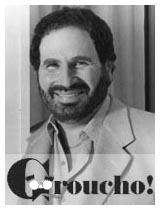 I’ve never seen WELCOME BACK, KOTTER, but as a teacher currently working at his former high school, I may well appreciate some of its content. But for me, it has always blended into the morass of TV shows that I have never seen live or in reruns due to my extremely limited exposure to television programming over the course of my youth. I have not been privy to the enculturating joys of SILVER SPOONS, THE WONDER YEARS, THE LOVE BOAT, HAPPY DAYS, or anything starring Scott Baio. Jimmy Baio, yes; Scott, no.
Regardless, aside from the fervored testimonials about the show from characters on FREAKS AND GEEKS, KOTTER was not a name to conjure with in my book. So the news that a local production of Arthur Marx‘s play GROUCHO was to star Mr. Kotter himself left me with no attendant feelings of awe and with no stars in my eyes. The fact that the script had been penned by Groucho’s son did pique my interest, though, and a fortnight into the run of the play, I wandered down to the Stoneham Theatre and plonked down a pretty penny for a fifth-row seat.
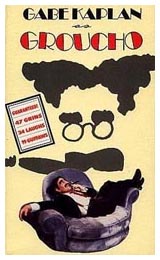 Kaplan immediately got my respect for addressing the basic difficulties of the performance: he doesn’t much look like Groucho. “He’s too tall,” Kaplan said about himself, beginning the play daringly out of character. “His face is too round, his nose is too big, his nose isn’t big enough…” I laughed, as the round face was what had first struck me. I was impressed that he was able to anticipate our varied responses so accurately. It turns out that Kaplan has been playing the part for some time, and a stage performance of the part was filmed for video back in 1982. He’s had a lot of time to work through quirks of the production, and with the one essential difficulty that he has a moustache and yet has to wear Groucho’s patented greasepaint moustache at one point, the technical aspects of the show were almost flawless. With a notable and wonderful exception: archival photographs from the Marx Brothers’ lives were projected on a screen throughout the play, and at one point a slide failed to appear. Kaplan effortless ad libbed and continued gamely. At other points, he departed from the script to poke fun at a fellow actor with a case of the giggles and to respond to the moments that made themselves available.
Most impressive, though, was Kaplan’s transformation from old Groucho to ancient Groucho. His vocal mannerisms and body language were so fragile, with the meticulous breathlessness of the dying. His glacial interplay with the young reporter that comes to visit him in his last years was amongst the funniest portions of the script because of Groucho’s dogged desire to make all of the jokes that he came up with in response to a situation, even if he could no longer crack them out rapid-fire. The timing was wonderfully funny and dry, even if it was the complete opposite of the style that had made him famous in his heyday. I have no idea if the timing was Kaplan’s or based on actual accounts and footage of Groucho in his end days. Regardless, it was convincing and real to a hilarious and heart-wrenching degree.
Lastly, let me say that while my first reaction to Mr. Kaplan was the response that he anticipated, the final moment of the play was him standing onstage with a large picture of Groucho in last years. And the resemblance was spot on. Kaplan may not have resembled Groucho in his film days, but the play was about his end days, and the visual parallels were uncanny. I sat there and had to eat my previous assertion: it worked.
Pre-Approved Veteran Status
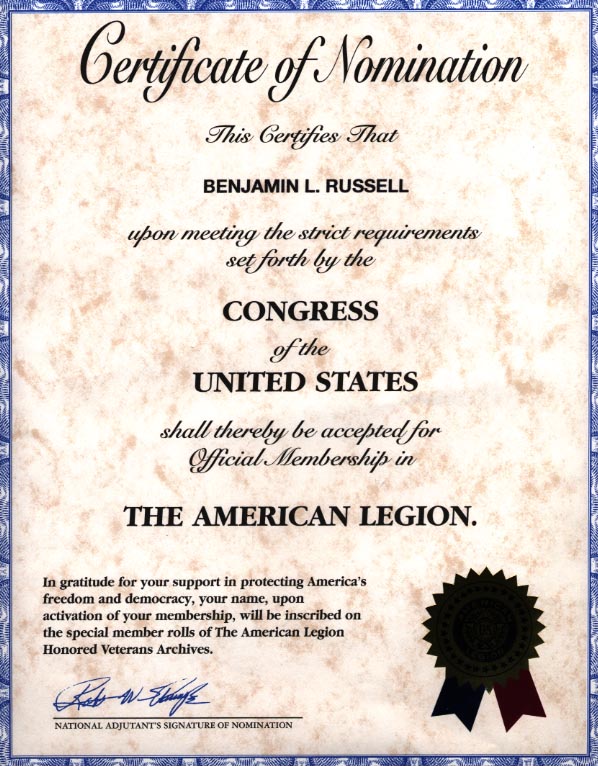 “Bob” sent me a large manilla envelope yesterday asking me if I was “taking full advantage and getting all the available benefits of [my] status as a war-time veteran”. Apparently “[t]he benefits are unbelievable!”
Well, considering that I’ve never been in a branch of the service — helpfully delineated for me (just in case I forgot due to Post Traumatic Stress Disorder or Manchurian Candidate Syndrome) by cutesy little stickers on the outside of the envelope — and therefore never served during war-time, I’m not sure I have been taking advantages of my fictional status! What a fool I have been. The only side-benefit of being a “war-time veteran”, which I was somehow able to work out even though the United States wasn’t technically at war with anyone during the period I was between the age ranges of Selective Service, I’ve only luxuriated under the advantageous hotdog availability at the local Legionnaire’s Hall on Memorial Day. O, what a rogue and peasant slave am I!
I’m definitely framing my Certificate of Nomination at once! Without delay! I only hope that not being a veteran won’t prevent me from taking advantage of these fine, fine veteran perks.
Kaiju: Superwrong
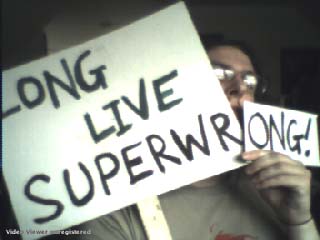 If Kaiju is wrong, then I don’t want to be right.
The inimitable James A. Wu has been working for Kaiju since he left his previous job at Comicopia, and is starring as the Asian Scotsman in Kaiju’s upcoming, as-of-yet untitled DVD. It was advertized as The Swarm in the trailer that premiered in between battels during the May 1st event. It was a welcome sight, as it had been since December that any pertinent information about the “Unsanctioned” Battel had been released from the Kaiju offices. Those photographs from the filming were thrilling in their way, but the Swarm trailer was wonderful. Specifically because Peter and I could each identify ourselves and our contributions to the melée. Now Kaiju simply needs to make it available on their Bideo Entertainment area, so that we can sent the link to everyone we know.
Anyway, it was fantastic to see James in person, if but briefly, and marvelous to see him in full Tartan-O-Vision on the big screen. And he gave me the Superwrong sign as pictured above, which became an object of both jealousy and total confusion as I carried it with me from the event and into the T. It made me feel like I needed to march up and down with it, like a lost and totally inappropriate refugee from the March For Women’s Lives. The sign also served to identify me as someone who had just been to the Kaiju event, which meant that more than a half dozen people came right up to me and started up conversations with me about the event, about the sign, about Kaiju in general. What was it about the sign? It didn’t say ASK ME ABOUT: KAIJU. It didn’t spell out the word “Approachable”, but somehow it intimated this very adjective to passers by.
Who’s got a stamp on his Mancini?
Shamelessly ganking the idea from Fraction‘s blog, I present to you the first stamp to be released in April of 2004: Henry Mancini.
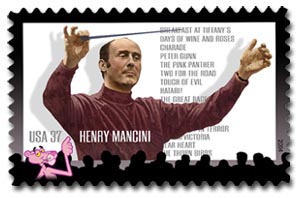 And why do I care so much about this? Well, gentle reader, squint your eyes and read the third title from the list of films presented in the background of the stamp. Ah, yes, the classic CHARADE fixation rears its beautiful, coiffed head once again.
Peter asked if I were going to purchase the upcoming Criterion Collection re-release of the disc in anamorphic widescreen even though I already owned the previous non-anamorphic letterbox release. It’s not as if you have a widescreen television that will really take advantage of the difference, he said, and I concurred, adding that the special features were exactly the same. However, when one is a fanatic and dedicated to collecting every possible version of CHARADE available on DVD, then it’s really almost a requirement. After all, I bought the DVD of THE TRUTH ABOUT CHARLIE just because CHARADE was available as a b-side, so I must clearly not have any powers of discernment when it comes to this particular fetish.
And since Criterion is offering a $10 discount to those who purchased the previous edition, there is now no question about my acquisition.
And while we’re talking Mancini and Hepburn, 20th Century Fox revealed in a Home Theatre Forum chat in January, that they are considering releasing TWO FOR THE ROAD on DVD. With Albert Finney’s recent success in BIG FISH, we can only hope that his old films may have a more marketable lustre.
I am not making her up.
I have solid, incontrovertible evidence that when Dave Barry tells his weekly readers that he is not making this up, he is — in fact — not making it up. Friend and former colleague Claudette Knieriem was name-checked as someone who sent in a ludicrous advertisement that appealed to Mr. Barry’s “Mr. Language Person” persona.
I just want to note, because I never get tired of mentioning this, that the ad originally appeared in Manchester’s The Union Leader, which was called by Hunter S. Thompson “America’s worst newspaper.” (p54.) Quite a claim to fame, say I.
Things I Hate About The 21st Century, No. 7
Things I Hate About The Twenty-First Century, #7:
- Ringtones that get stuck in my head.
Getting a song stuck in my head is annoying, but it is a phenomenon that I have come to accept. Songs are written to be catchy and memorable and they are overplayed in order to force you into commercial submission. This is the backbone of the record industry, and while I don’t respect the practice, I at least acknowledge that it’s been going on for long since before I was born.
Ringtones, however, are things with which I am contemporary. Therefore their increase and evil nature are something that I possibly could have prevented, and this makes them that much more abhorrent. Particularly when a six-second electronic, sub-MIDI snippet of sound gets stuck in my head. It’s not even music! I don’t get my alarm clock buzzer stuck in my head, and that’s an equally annoying and equally repetitious electronic tone. And yet, I don’t find myself walking to my car absently chanting, “BWAAAAP! BWAAAAP! BWAAAAP! BWAAAAP!”
I did, however, find myself murmuring, “Dee di doo de, dee di dooo de, dee di doooo doo deeee…” to myself over and over again while I was working today. My employer’s cel phone rang three times and that was sufficiently repetitive to have the [snark] melody [/snark] stuck in my head.
Ah, crap, just typing it out is going to be enough to have it gain clawlike purchase upon my psyche again, I just know it.
EDIT: Ahhh! It’s based on “actual” music. It’s corporate identification synergy, but still an excerpt from a composed segment of a larger piece of music. I feel somehow vindicated.
PVP: Star Wars vs. Annie Hall
Scott Kurtz has written a strip for December 27th where he claims that nerds are demanding reparation for Star Wars losing the “Best Picture” Academy Award to Annie Hall in 1977. Now, I remember the Best Film internet poll a year or so ago when a bunch of iSavvy revisionists took to the bulletin boards across the web and “proved” that there was more popular support for Star Wars to have received “Best Picture” in the 1977 Oscars. There was some minor flap about it as people who actual had taste and perspective were outraged and everyone who registered as “Jedi” for their religion in the 2000 census celebrated this overturn. But because it was an internet poll, and therefore statistically representative of, um, nothing, people eventually forgot about it. Also, a new personality test had been created and everyone needed to see which Angel from Neon Genesis: Evangelion they were, or something. Anyway…
What I object to in this comic, is not simply its sentiment. It’s the use of the character who voices this sentiment. I don’t know how old Mr. Kurtz is; I assume he’s in his early thirties. In reading PVP, I have regularly found that I believe Mr. Kurtz places his editorial voice, the voice representing his age and life experience in the voice of Cole, the most aged character in the strip. Cole is the character who says that the Nerd Community is instigating for reparations for Annie Hall‘s “Best Picture” award.
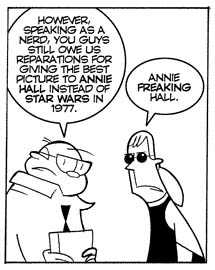 Cole is old enough to have the perspective that Annie Hall very much is a Nerd Movie. It is a series of nerd fantasies, strung together in Allen’s signature nerdy perspective. Who else but a nerd would open his film with references to Groucho Marx and Sigmund Freud? Who else but a nerd would portray his girlfriend as a sexy rendition of the Evil Queen in Disney’s Sleeping Beauty? Marshall McLuhan steps out from behind a sign to prove Woody Allen’s character’s point: a total nerd fantasy.
Nerds didn’t become so codified, so specialized until after the Star Wars phenomenon. By the 1977 Oscars, Star Wars hadn’t even been re-released in the cinema with the “Episode IV” subtitle. It made a supreme amount of money and took the toy market by storm. It stayed in theatres for almost a year before being shelved and re-released. These are indicators of a great popular devotion, no question. But it wasn’t just a nerd thing. Look at the “Cancellation of Star Trek” skit on Saturday Night Live or the Trek references in the film Serial. These show that the appeal was broader than the Nerds. Nerds were literary fiends and HAM radio operators and Hi-Fi geeks and classical music DJs and political activists. They also read Greg Bear and Lester Del Rey and Philip K. Dick and were entranced with science fiction. But not just Lucas’ science fiction, but also the science fiction of Asimov and Serling. And they didn’t lock themselves into a narrow, narrow spectrum of interests: sci-fi, fantasy, comics, and computer games. Annie Hall shows beyond a doubt that the Nerd has withered. He is anaemic and inbred. And if he lacks the perspective to see that Annie Hall is his antecedent and his legacy, than he deserves nothing.
Or, to be more precise, he deserves precisely what he is getting. Hope you enjoy Episode III, Cole and Mr. Kurtz. They are what you demanded by not accepting the Oscar in 1977.
For Candidate For President For America

Download a print-resolution version here. Suitable for placing on your bumper. Also available at my long-time-coming CaféPress store. I’ve been a member since 2001, and have never quite managed to finalize the designs that I’d had kicking about in my head. However, I now have two stickers available online, with more MelbaMadness to follow! Watch this space!
Tim Calhoun’s platform speeches can be found on FallonFey.com. Download from 2003-2004: Andy Roddick, and from 2002-2003: Ray Liotta and John McCain. RealOne player required.
 RSS feed
 smartovercoat.com