Ambrosia Parsley
“My parents weren’t really hippies. They were a cross between hippies… and bikers, and… and my father was a lineman for the county. And we lived in Reseda, me and my twin brother and my older brother, and my mother and father. And one day we heard that a CostCo was coming to the area. And this was a huge thing, this was like the Emerald City. And my father was able to get a get a card, and so he and my mom went to the store, and left my older brother to babysit me and my twin bother until they got back. And they were gone for, like, three hours. And we sat at home and, and we had all these visions of, you know, these huge packages that they might bring back, like a container with two hundred and eight Twinkies. And when they finally got back, all that they’d bought was an enormous bottle of NyQuil — and really, it was huge, it was like… this big — this huge bottle of NyQuil and a giant container of Flinstones Chewable Vitamins.
“So, the next time my parents went to CostCo, leaving my twin brother and I to be watched by my older brother, we really liked cowboy movies. We would always watch John Wayne movies and so we went out into the back yard and we stacked up six cinder blocks, three on one side, one on top of the other, and three on the other side. And then we put a piece of plywood across it, and this was our bar. Because in cowboy movies, all the important stuff happened at the bar. And we got out the bottle of NyQuil because it came with that little shot glass as part of the cap, and people were always doing shots in cowboy movies. Another thing we used to watch a lot was Three’s Company, and there was a bar in that too, the, uh, the Regal Beagle. Right, the Regal Beagle. And they were always eating little bar snacks out of a bowl at the bar of the Regal Beagle. And, well, we had a bowl… it was wooden, you know, parquet… and so, we poured a bunch of Flinstones vitamins into that for bar snacks and placed it down at the end of the piece of plywood.
“And so we took turns. One would be the bartender, and the other would have to go all the way to the other end of the yard. And you’d hook your thumbs in your belt loops and walk towards the bar. And we made the sound of spurs with out mouths as we walked. ‘Ching. Ching. Ching.’ And when you’d get to the bar, you’d pour out a NyQuil slammer and slide it across the bar and knock it back. And then you’d eat bar snacks. And then we’d switch, and then we’d switch again.
“I don’t know how long we did this, but I remember seeing my brother lying on the floor of the hallway… and then I remember blacking out.
“When I woke up my dad was there and there was a doctor in the house. I’d never seen a doctor make an actual house call, but there he was, and he had a black bag and everything. And out of the black bag he took some Ipecac and he gave it to us. And so we were sitting on the couch, and they brought in these saucepans, and we were throwing up and crying because no one likes throwing up. And my dad was trying to cheer us up, and he was pointing into the saucepans full of this green… and he was saying, Oh look, that’s a good one. Look you can still see Betty’s head. Oh, there’s Dino…
“So, this next song has nothing to do with that. This was written about my first crush. He was 15 and I was 12. And then he was killed. And I went to his funeral. He was my first dead boy. Yeah.”
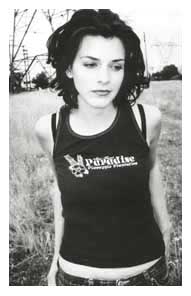 The above is a approximate and reconstructed retelling of the introduction Ambrosia Parsley of Shivaree gave to a song tonight during a performance at MassMoCA. It was not only hilarious, and a fascinating combination of rambling and expertly-told, but it great fun to watch the other five members of the band settle and wait for the conclusion of the tale. Their reactions ranged from the totally impassive, to the entertained, to the deeply impatient.
Anyway, just to say that I always pay particular attention to a musician’s ability to create patter between herself and the audience, to establish rapport and to speak what is usually fairly canned material in a naturalistic way. In a concert that involved a minor amount of technical heckling from the audience (I rather feel that some people were not expecting the cacaphonic and occasionally dissonant phantasmagoric sound mix that is the predominant sound of the group), and some excellent return heckling from the frontwoman, perhaps ten to fiteen minutes were taken up with similar storytelling. Not seques, particularly, but clearly performances in their own right, even if they weren’t actually on the set list.
Shivaree’s excellent singles are available for MP3 download: “Goodnight Moon” is the potentially-familiar radio single from the 1999 album, I Oughta Give You A Shot In The Head For Making Me Live In This Dump. The newest album, Who’s Got Trouble has a completely different line-up of collaborators and backing musicians, but the single “Close My Eyes” is catchy and fantastic.
Beijing Bicycle
 The first musical artist I ever seriously listened to, eagerly awaiting the release of each new album, was Weird Al Yankovic. While other kids were discovering the Beastie Boys and Tiffany, my musical diet consisted of Weird Al and Tom Lehrer. So parody is practically my native tongue.
Which may be why this article particularly tickled me, much in the same way that Erica-Lynn Gambino‘s take on William Carlos Williams’ “This is just to say” did. A new UK single by “identikit singer/songwriter” Katie Melua entitled “Nine Million Bicycles” has come under fire by cosmologist Simon Singh. Singh takes issue with Ms. Melua’s cavalier lyrical treatment of the scope of the measureable universe in a column in the Guardian United:
We are 12 billion light-years from the edge,
That’s a guess,
No one can ever say it’s true,
But I know that I will always be with you.When Katie sings “We are 12 billion light-years from the edge”, she is suggesting that this is the distance to the edge of the observable universe, which in turn implies that the universe is only 12 billion years old. This is incredibly frustrating, because there are thousands of astronomers working day and (of course) night to measure the age of the universe, and the latest observations imply a universe that is almost 14 billion years old, not 12 billion.
…In short, Katie Melua has no right to call the age of the universe “a guess” or quote it as 12 billion years when we now know it to be 13.7 billion years old. You might think that I am being rather uptight, but the role of the scientist is slowly being undermined with a growing belief that scientific results are merely subjective guesses that go in and out of fashion. In fact, scientific results are a careful attempt to objectively measure reality, and although they may be refined over time, they are always our best hope of getting at the truth. In light of this, I propose that Miss Melua rewrite her opening verse so that it reads:
We are 13.7 billion light-years from
the edge of the observable universe,
That’s a good estimate with
well-defined error bars,
Scientists say it’s true, but
acknowledge that it may be refined,
And with the available information,
I predict that I will always be with you
Most hilarious, even if it doesn’t scan. I actually have to agree with Mr. Singh, particularly in light of the recent article in the New York Times about the decline in elementary scientific knowledge, including the jaw-dropping statistic that one in five Americans actually believes that the sun revolves around the earth. However, the song is criminal is other important ways: it’s dull, it contains a cheekily-Asian chord pattern in the intro, and comes complete with a bizarre music video that starts as if it’s going to be structured in an homage to the classic “Powers of Ten” video, and then just goes… silly.
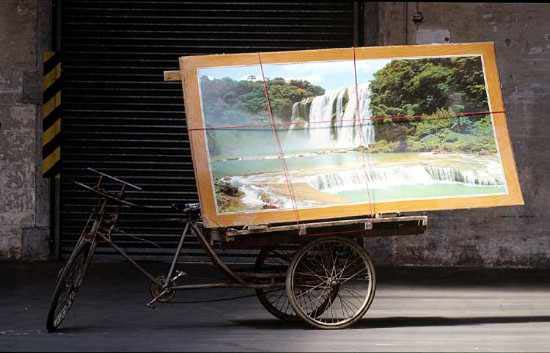
Another bright spot in all this was the discovery of the Fixed-Gear Gallery, a series of photographs of bicycles as an art form.
Thanks to Andrew Hogg for the article and John Mazzeo for the epithet.
Toast Julienne
Sometime in August I did a massive design update on the site, as I finally figured out how to use Blogger’s archive function, something that had been eluding me for, yea, these five years of membership. In doing so I also instituted the comment function so that the site can be a little more interactive.
This immediately paid off. Back when I first made a website in college, I can recall searching for various pop culture homepages and tribute sites and finding nothing. It was an incredible thrill to dedicate a section of my website to the television show Nowhere Man, and have it be one of two relevant things that came up in a Google search. And because the web was still thin and rarefied at that time, I actually got an e-mail from the show’s creator, Larry Hertzog, who had found my page in a similar search.
Now that the web runneth over with content, I never assumed that similar things would happen, but immediately after establishing the content function I have received comments from the screenwriter of Charade-knock off Duplicity and from author Julian Gough.
 Mr. Gough was incredibly nice, answering my little questions about his previous works and his former band, Toasted Heretic. He mentioned that the band’s first two albums were being released for the first time on CD and would be available through the indy music retailer CD Baby. The disc was released on September 23, against all conventional New Music Tuesday rules, and CD Baby didn’t have a link to it until the following day, and I’d only just posted. So in order to maintain my one-post-a-week consistency I said that I’d write all this up for New Music Tuesday on the 27th, and promptly forgot.
So here we are now.
And since I’m well aware that none of you have the faintest clue who Toasted Heretic are (unless, of course, you found this entry by searching Google’s new blog search for “Toasted Heretic”), I recommend that you download “Lightning” which is charmingly energetic, and “You can Always Go Home“, which I think gives an indication of how much fun of a live jam band they must be. Remember that you can download these with impunity; on the liner notes of the album, the band is quoted as saying, “Our principle on PIRACY and COPYING STUFF remains the same as it always was: copy this album for your poorer friends, and make the rich ones buy it.”
In other update news, I have also redesigned the Pan~Theism page, and will be adding new weekly strips to it on Wednesdays. We kick this off with a computer-generated comic made with the online Strip Generator, as pointed out to me by Nick Locking.

Cackles of Compassion Lite
For those of you who miss the ability to listen to Ben, Ken, and Dimitri’s revolutionarily self-indulgent college radio show as recreated through the magic of Live365.com, I have a partial solution: Last.fm and Audioscrobbler.com.
 Audioscrobbler is plug-in that allows you to send any music that you play on your computer to a user account. This user account is hosted by Last.fm, which synchs your data with a fairly vast collection of licensed music, which allows you to listen to a streaming audio radio station that is based upon similar music to what you’ve played on your personal computer. One can also listen to the music favoured by one’s “musical neighbors”, people who have listening profiles similar to your own.
One only gets a month of free personal radio, which begins immediately after creating a user account. Listening to one’s neighbors is always free, but less likely to simply be music one likes. If one wants to be able to listen to one’s own musical tastes wherever one has a computer and a sufficiently speedy ‘net connection, one has to pay a “minimum suggested donation” of twelve dollars for a year’s subscription. Cheaper than National Public Radio.
So what’s the point? Signing up with Last.fm and listing me as a friend means that you can listen to my personal station, which is essentially like listening to Big Cackles of Compassion. The bands that Last.fm has in their library is quite compatible with my tastes: they have the eels, Suzanne Vega, Stacey Kent, The Smiths, Belle & Sebastian, Propellerheads, tAtU (in Russian!), The Cure, Frou Frou, Ani DiFranco, The Shins, The Who… If only they had a little Tom Lehrer and some more Stephen Sondheim, it could be just like the snippets of music that Dimitri and I would play between our interminable on-air conversation.
Also, how can you go wrong with an online service that promises you a pony when you subscribe?
Nature’s First Green is Gold
I’ve been watching the trees go from the pallid yellow color of winter survival to the brighter yellow that Robert Frost and Ponyboy spoke about. And within the last week, most of the deciduous foliage in my part of the world has graduated into either a lush variance of true greens or bursts of blossoming flowers.
All of which has lodged Deb Talan’s song “Cherry Tree” firmly in my vernal head. Here, therefore, is the third and last of my Spring Songs for the season. Unfortunately, neither of the links I could find are downloadble, but are instead streaming audio. However, if you like it, I recommend checking out “Tell Your Story Walking” from Ms. Talan’s homepage, and those two songs should hopefully convince you to hunt down Sincerely, which I consider to be the best recorded reproduction of the live, acoustic, small-venue experience. Sadly difficult to find, as I believe it’s out of print, it’s worth the search. “Tell Your Story Walking”, by the by, is based upon Jonathan Lethem’s Motherless Brooklyn.
EDIT: Sorry, not Motherless Boorklyn, which is either a typrographical error or a post-modern crime drama about the Swedish Chef with Tourette’s.
The Song of Soda
Here’s how I’ve been frittering away my time recently: the X.3 version of the Macintosh OS supports a version of iTunes that allows one to display the cover art of the album in conjunction with the song playing. The Jaguar version didn’t do that, and so I find myself with a staggering 1150 songs — mostly acquired in 1999 during the heady days of AudioGalaxy… sorry, Copyright Cops — with only the barest handful linking to an image file. And there doesn’t seem to be any way of sorting the tracks by available cover artwork, so it’s difficult to mount a planned mission to fill my remaining slivers of hard drive space with 200 by 200 pixel JPEGs.
 So if I find myself with an idle moment or — heaven forfend! — doing some reading for my Adolescence class, I turn on Clutter and keep my fingers resting near the keyboard. Clutter searches for album cover artwork through Amazon.com, which one can paste into the system easier than if one was trying to drag and drop the data from the otherwise impeccable Firefox. Useful little toy. Because Clutter associates the artwork with the album file instead of the individual track, it’s difficult to know how many songs I have artwork for. Still and all, I’ve acquired 133 folders of artwork for 443 folders of musical artists. Not bad.
Speaking of iTunes, a very attractive married woman comes up to me yesterday and hands me a bottle cap, and I take it from her, wondering briefly if this is some variation on the old grade school pull-tab code, and how she’s going to take it when I remind her, gently, that she’s married. However, the cap’s got some sort of PepsiCo iTunes code under the cap that allows me to download a tune for free. I’m reminded of the album and a half of varied songs languishing in my virtual shopping cart and am well pleased. More pleased, perhaps, than if she’d handed me a pull-tab.
Anyway, I must say, it made me go out and buy a Pepsi-brand soda in attempts to get another free download. Hard to argue with the fiscal logic: spend 34¢ for twenty ounces of sugar water and buy a song I was going to buy anyway. Or, alternatively, spend a mere 84¢ for a soda and get half off the cost of a song. iTunes wins, the record labels win, PepsiCo cleans up, and I’m happy; everyone is happy, in fact, except for the communists. Good thing the offer ends tomorrow, or I could see this behavioral pattern getting well-entrenched into my buying habits.
And speaking of downloadable music, the other vernal song that frequently occupies my mouth and mind during this time of year is Tom Lehrer‘s blissful “Poisoning Pigeons in the Park” from the Another Evening Wasted With Tom Lehrer album. Sublime stuff.
It Might As Well Be Spring
Spring is such a shameless flirt. I recall blogging a couple years ago about the most vehement, school-stopping snowstorm of the year happening on the Vernal Equinox, so I am well aware of the fact that a few sunny days and an active moist breeze does not Spring make. But despite any intellectual pattern recognition and despite the fact that we have only just passed the midpoint of the slow computer morph of lion into lamb, I have caught Spring Fever. I am disappointed every time I realize that while it looks glorious outside, it’s still too chill to abandon my heavier wool topcoat in favor of my more traditional black cotton.
Still, the seven inches of show we received last week melted away within two days, and the crusties and hippies have emerged, blinking, from the heated confines of Café Koko and started lingering outside in a cloud of smoke and grime, so while Spring may not actually be here, we are certainly well into Thaw.
Celebrate early with me. Have a listen to Stacey Kent‘s marvelous, swininging “It Might as Well Be Spring” from her Rodgers and Hammerstein collection In Love Again.
Janus & Juliet
Well, it’s January, and everyone is trotting out their Best Of lists for the previous year. I’m not much for lists myself (sorry, Kelly Sue), although I did finally get on board the YMDB.com train.
 Anyway, I was reading the Onion AV Club‘s round up of the best books of 2004, and was forced to come to the sad realization that I did very little pleasurable reading this past year, and, indeed, very little reading at all. 2004 for me was the year of television, as I embraced television on DVD
 and indulged in a fair degree of BitTorrenting. I was so engrossed in preparation for my class on Jehanne d’Arc and my production of The Philadelphia Story that I was frequently burned out on reading after having done so much research. Not that the reading wasn’t pleasurable, but it wasn’t what I normally read for pleasure.
All of which means nothing has yet to surpass the best new novel I read three years ago, Julian Gough’s Juno & Juliet. And was the best book I read in 2004, as I had to re-read it to prepare for a book discussion group filled with six nervous sophomores who were each wondering why on earth I had chosen this book to make people read over the summer (Answer: Depreciating remarks about John Barth, positive comments about Gregory McDonald, and the best Acid Trip Revelation put to pen — particularly because the insight evaporates with the high, as it should).
But thinking about J&J made me wonder what the author had been doing since 2001 and indeed what he might have done before. So I spent a few hours last night trying to track down the “satirical serial” he wrote, as well as the “successful stage play” he co-authored, according to the About The Author copy. No luck. Also no luck finding downloadable versions of songs Gough sung with Toasted Heretic, despite the fact that he expresses support of internet music distribution venues.
“Oh, I love Napster. I hate the music industry, I’d love to see it destroyed. Please feel free to download Toasted Heretic songs from Napster, Gnutella, AudioGalaxy, MP3.com…”
However, I was able to find a PDF file of a chapter from Gough’s upcoming work, as published in the British Council for the Arts’ anthology New Writing 12. Entitled “The Great Hargeisa Goat Bubble”, the anthology says that the excerpt is about “how a dead-goat-compensation scheme gets out of hand and the UN steps in”. How this will fit in with the entire novel, to be titled Jude O’Reilly, and which his CV describes as the opposite of “beautiful, realistic, psychologically acute, and narrated by an intelligent 18-year-old girl”, is yet unclear. Some more information is provided by the Arts Council by way of an MS Word document (55 Kb) interviewing Gough about the excerpt, and this wholly unrelated link to a RealAudio interview with the author is also quite fun.
However, none of that answered the question I’d originally hit the net to find out. So if anyone can let me know what the title of his play was, I’d be extremely grateful.
Journals: Live and Otherwise
If I had a LiveJournal, today’s header would look something like this:
Feeling:
Cold.
Listening to: “Like the Weather” by 10,000 Maniacs, In My Tribe
Fortunately, I keep myself to merely blogging, which is slightly less touchy-feely. The lack of comments and drama is really what appeals to me; I understand that many people feel that the greatest potentiality of the graphic interface computer is one of interactivity, but I’d rather not interact with every house-ridden emotional basketcase available simply in order to fulfill my computer’s potential. And, as a Konfabulator widget cheerfully informs me, I am using between seventy-three and ninety-one percent of my CPU capacity at the moment, so I feel like potentiality is pretty damn close to being achieved. Or perhaps I simply need a new computer. First, however I need a graduate degree and a job.
One more thing about journals: after being asked by a fellow student about what a high school freshman might enjoy reading, I pulled out my sophomore-year diary, in which I recorded each book I read over the course of my sixteenth year. I was pleased to find a vaguely practical use for the contents, for — as with every time I pull the journal out every few years, once the previous pain has receded — I re-experienced my usual response to reading the facile writings within: why haven’t I set this on fire and scattered the ashes?
Something to think about when I revisit these blog entries in twenty years.
Sophomore Albums
Second Albums. Why are they so difficult? What, precisely, is the hurdle that makes so many reviewers refer to an artist’s “sophomore effort” in tones most frequently encountered in an oncology ward? Perhaps we expect one-hit wonders, or perhaps we are sufficiently aware of the tumultuous marketing of music, and therefore know that studios may have already abandoned their recording artists by the time the second release hits shelves. Why continue to support and help an artist mine the depths of creativity when one can move on to the Next Big Thing, the Bigger, Better Deal?
Or perhaps it’s simply novelty. A new record by a new artist is something one has never heard before. The balance of sound and words, or rhythm and melody, the particular tenor of a person’s voice are all new and therefore interesting. If the music hooks one, in a particular aspect or in a combination, then one tends to investigate the entire album closely, obsessing over and absorbing the minutiae. And the unfamiliarity is half the attraction, the novelty is key.
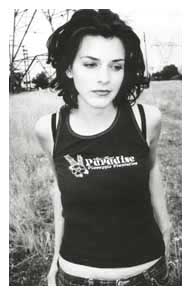 So a second album has a difficult hurdle: it must still be novel, but it must also capture the elements that made the first album appealing. So it must be the same only different. And that is a teetering totter that is difficult to straddle.
Now, I rather enjoyed Norah Jones’ first album, COME AWAY WITH ME, despite my childish inability to listen to the radio single without sniggering lasciviously (“That’s alright, dear… it happens to everyone and is nothing to be embarrassed about.”). And I knew that she was going to be in a tough spot with a second album: would she continue to push Blue Note into the mainstream? Would she slip from torch songs into the slimy ooze of light jazz? Would she move the opposite direction and sidestep into a more produced pop sound? How could she maintain her established tone and sound and not be charged with the crime of not having moved, grown, or progressed? Her second album is described as tinged with a Country & Western sound, complete with guest-vocals by Dolly Parton. But, as The Guardian rightfully sums up (after some needless but entertaining vitriol), the album is so ephemeral that one might “have trouble remembering whether you put it on.” I skimmed through the tracks at the preview station at my local record store and found myself unable to be hooked by any of the songs. Nothing grabbed, and so I left empty-handed.
Also on the torch song front, Shivaree‘s first album, I OUGHT TO GIVE YOU A SHOT IN THE HEAD FOR MAKING ME LIVE IN THIS DUMP, was a delight. Raspy and clever and sensual, it created an idealized post-modern nightclub in one’s head. The follow-up album, ROUGH DREAMS was due out in September 2002. Almost two years later, the album remains unreleased domestically, available only as an import. Where is the band? Where is the album? Perhaps this album was too different; with only a pair of songs maintaining the sort of sound that the band had previously established, ROUGH DREAMS might as well be by a different band. Were the album actually to be released, I’m sure the series of minor publicity interviews in the music mags would be full of dialogue about a “bold new direction”. Would it only be the third album before their press releases indicated that were “returning to their roots”, or would they have to wait until the fourth album? I should look more closely at the production credits between the two albums, as perhaps this is like the difficulty The Murmurs had with their second album, PRISTINE SMUT. Yanked quickly after release and remaindered, eight out of eleven songs were re-engineered and re-released as the appropriately-titled BLENDER. Perhaps ROUGH DREAMS will eventually see a domestic light of day with a Paul Oakenfold credit and the title CUTTING-ROOM FLOOR.
 I had to listen to Sarah Harmer’s second studio release ALL OF OUR NAMES a few times until it started to seep into my head. Still, I knew that it was going to. After the first listen it created a familiar, dissatisfied feeling that was not a disappointment with the content, but a keen awareness of the fact that I hadn’t been able to receive all of the transmissions. That the poetry had passed me, that the songs hadn’t stuck in my head. There was no stand-out single or eminently hummable tune, but there was a sense that the album was large enough and deep enough to warrant further investigation.
But most impressively, the first track on the album, “Pendulums”, sounds exactly like it could have been a b-side or a hidden track from YOU WERE HERE. The tone and the energy are totally compatible with the previous album, providing a bridge between what has been and what is about to be. The album then moves on to a consistent sound that more active, more band-inclusive than the previous work, but without sounding like the songs could no longer be performed by a Woman and Her Guitar. Ultimately a little short, and shrinking to a quiet close over the last three cuts, ALL OUR NAMES is almost a pitch-perfect example of how to dodge the second-album blues. It feels like another chapter in a body of work, instead of sounding like a publicity stunt or a press-release or a critical re-evaluation of image. It continues to be songwriting and songs themselves.
 RSS feed
 smartovercoat.com