MEME: Business Card Gallery
One of the great things about the web is the depth to which people will go to catalogue and display seemingly trivial data. To the average person, such websites are neat, but clear evidence that the provider has no life, or has too much time on his hands, etc. I think it’s a pity that these efforts are trivialized in this manner. Inspiration is momentary, and the hard, dedicated slog from idea to fully-fledged execution takes time and commitment (q.v., again, Patton Oswalt’s insightful and vulgar commentary about Death Bed: The Bed That Eats People). It’s easy to look at a finished product and airily dismiss it as a waste of time, but it’s an accomplishment to be in the midst of that use of time and not throw up one’s hands and abandon the project in process once the initial glimmer of the idea has cooled to a faint grey ash.
One of my favorite instances of dedication to the seemingly trivial is Steven Hill’s Movie Title Screens page, wherein he takes screencaps of the appearance of the title in the film itself. Not to be swayed from his own parallel inspiration, Christian Annyas takes caps of the title image, any instance of a “The End” or “Fin” screen, as well as the title logo from trailers of a given film (which, due to marketing, are frequently different than the title within the film itself). And, yes, he has capped Charade. Is it terrible that either of these men has devoted so many hours of time to this project? Particularly when someone is doing essentially the same thing? Not to be hyperbolic, but that seems a little like saying that Samuel Johnson was an idiot, and Noah Webster and James Murray were compounded morons. Who had no lives.
Just to avoid misinterpretation of the above rhetorical: no, it’s not terrible. Reference is a wonderful thing, and it requires meticulous, sustained effort. I realize that I’m a librarian, and therefore biased, but — in a nutshell — it’s only trivial and dismissable if you don’t find it useful. If you do think it’s the most useful thing since a breadknife, then you’re surely not going to say about IMDB or Google or the phone book, etc., that whoever compiled those data had too much time on their collective hands.
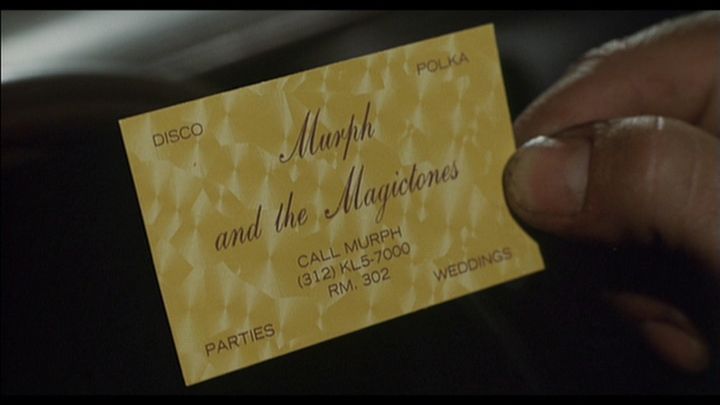
None of which probably justifies my own nascent Steven Hill-inspired collection of screencaps. I forget what I was watching, but it occurred to me that practically every shot of a business card in a film is the same shot. They’re probably all second-unit insert shots using a hand double. They’re almost always at a slight tilt, in order to give the card some substance and not to have it rigidly framed by the shape of the film itself (interestingly enough, even Wes Anderson follows this and doesn’t apply his typical hyper-formal use of symmetry). So I started collecting them, just to see how pervasive this was. I figured once I got fifty or so, I’d compile a list and send it out for further contributions, and once I got a hundred, I’d start my own useless, whimsical reference website.
In the interim, though, I tripped over The Dancing Image‘s gallery meme, as mentioned by Glenn Kenny. I like it when Glenn posts a meme contribution, because he doesn’t tag people, he doesn’t forward on the chain letter. I don’t either, mostly because I don’t have any readers, but also because I don’t like the imposition. Be inspired to contribute, or don’t be. In honor of the meme, I present my meagre collection of Business Cards in Cinema:
A Clever Ruse
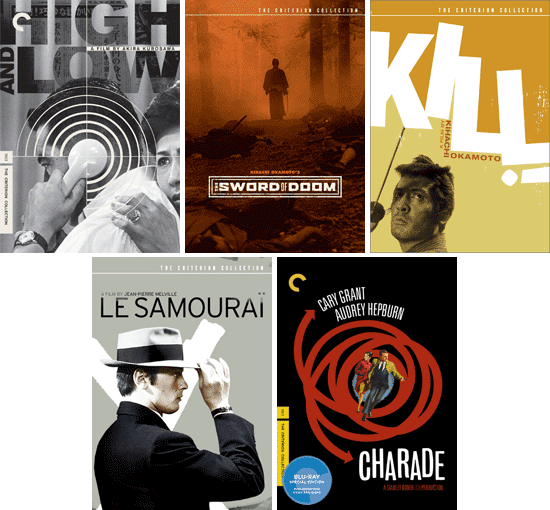
Un/Stage, a visual art and design website, has posted a list of what they consider to be the best “50+ Examples of Criterion Box Art“. “50+” apparently translates into “58” when someone actually counts, all of which I find a little odd. Lists, especially online lists, are not designed to be inclusive. They’re designed to do two things: first, to declare with grim (but anticlimactic) finality that The List Maker is an expert, an expert with the discerning taste to decide what stays on the list, and what is cast aside and kicked to the curb. Making lists, as anyone who’s tried to get into a fictional club in a film or television show knows, is about making those who are on the list feel more valuable at the expense of the egos of those left standing in line outside, imprisoned by the flimsy confines of a velvet rope and a bouncer’s level stare. It’s the special meteorological sparkle of having a rising tide lift just a few boats, and leaving the rest in a kelpy ebb.
The second purpose of a list is to generate chatter, which is why websites love them, and why any perceived expert finality is never the last word. By excluding things, you bring the commenters out of the woodwork, clawing at their keyboards and griping, “You’ve left out My Favorite, you swine, which clearly deserves inclusion, much more than your pathetic examples!” Now, perhaps a more charitable person who doesn’t have the “No Really, Shut Up” Greasemonkey script installed on his browser (Thank you, Chris Lamb) might say that such commenters aren’t purely motivated by bile. That instead, with a population of young writers in the midst of overwhelming media diversity, these commenters are helping to shed light on forgotten or niche corners of cult fandom that might have escaped the experience of The List Maker. It’s not a bad point, except that, well, I tend to think that the niche corners of the internet are populated by — as Victoria Coren reminds us — the sort of people who have a desperate fetish to be eaten by someone else, and I really don’t want to hear from them which whatevers really should have been kept on a given list.
But inspiring people to feel left behind in the velvet cordon, unworthy and sidelined, remains a good way to get them to comment, and comment breeds comment. Because the engine of the internet is not so much porn, as it is rage. Rage, rage against perceived slants against my values and the value of my individuality! Internet lists are written to engender such things; as the Criterion Current newsletter put it, “Whatever way you get your clicks”. Nyuck, nyuck, etc.
So. If any of that is true, what’s odd about the Un/Stage list is that it’s too inclusive. It can’t even keep it’s list down to fifty examples, and has to let it bleed out into a flabby fifty-eight. What seems to be the obvious implication here is that Criterion are such wonderful designers that it’s simply impossible to whittle the list down to a mere fifty examples. That only fifty wouldn’t show the breadth and depth of their aesthetic.
Whereas I return to the first criterion (unintentional pun, I swear) of list-making: if you’re not putting limits on what is In and what Isn’t, then you’re not sufficiently or successfully establishing your tastes or rubrics. And it becomes such a fluffy, inclusive exercise that it becomes difficult to see why you excludes some of them at all. Why not just post a link to the Criterion Collection website, Un/Stage? Your selection of cover art is broad enough that I can say, “Yeah, there’s some good work there,” but not be moved in any way by it (note: clearly a lie, or else why am I typing all this drivel? Read on…). This is why Top Ten lists are good, and that the Top 5 discussions in Nick Hornby’s High Fidelity are even better. They give the reader/listener/observer a clear indication of core taste, of core qualifications.
So, I present to you my Top 5 current Criterion Collection cover art. And all of the preceding waffle may or may not be a vast smokescreen to conceal my unbridled excitement that Charade is being re-re-released by Criterion, this time on Blu-Ray disc. I get to buy Charade again! I’m so pleased.
BRIEFLY: Don’t Take Maine For Granite
Dear Tony Scott, and the producers, writers, and FX team for Enemy of the State:
If your second-tier bad guy is going to be a conservative Republican from New Hampshire — and why not? There’s a fine pedigree of inspiration to justify the characterization — don’t have a scene where your ex-NSA tech genius pulls his address off of his phone records and shows his residence as being in Maine. MAINE! That’s an outrage!
Oh, and I see that the IMDB points out that the zip code for Maine on his address is for Washington, DC. And as the screencaps below show, his name changes from “Sam” to “Steven”. Last I knew, Samuel wasn’t a derivation or nickname of Stephen, as one is Hebrew and one is from the Greek. Well done, everyone. Well done, indeed.

Michael Bay Shout Out
Well, after three weekends with the top box office results, Transformers 2: Racist Boogaloo has finally been knocked out of the number one spot by Brüno. I’d like to say, “by Brüno, of all things…” but I still recall the mysterious favourable fervor that surrounded the first film. I figured the gay angle would cancel out middle America’s post-Jackass love of Sacha Baron Cohen’s antics, but he’s still riding the crest of that bizarre gestalt of reality programming, schadenfreude, and our tendency to laugh when we become uncomfortable (q.v. The Office and Fawlty Towers) for lack of any better response. Or he’s got a post-Borat curiosity factor buoying him up temporarily. I mean, there’s no way he’ll still be there next week when (500) Days of Summer the newest Harry Potter comes out.
(A brief note on box office records: some nerds are understandably upset at Transformers 2: Transformener! creeping close to The Dark Knight‘s nigh-toppling of the classic Titanic record. I don’t put much stock in box-office records — despite having once written to a newspaper to set them straight about Spider-Man‘s domestic gross — but it was still gratifying to read that someone had finally done an inflation adjustment for the top-selling films, to find out exactly how much blocks are really being busted by all these spidey-come-latelies. And while Titanic is still in the top ten (Star Wars is at number two, but I can’t tell if that includes the 1997 special edition re-release), Spider-Man, as the Guardian puts it, is “nowhere to be seen.” Makes one feel like someone suddenly turned the gravity back on, and realigned magnetic North.)
 I don’t particularly care what succeeds instead of Transformers, so long as something does. People talk about Michael Bay as a spirited visionary, someone with a good sense of populism and energy. I begin to grow tired of this particular paean. It seems to me that this is a kind of shorthand for “charismatic, improvisational egotist.” The same sort of tribute was paid to Peter Berg’s Hancock, and that was a dreadful mess. Good moments, but incoherent overall. Other films that don’t stand up to any sort of logic test, but which people adore for a few catch-your-breath, coolness moments: Bad Boys, Bad Boys II, Armageddon (referred to as “Armageddoon” in my household because of the fortuitous happenstance of a mislabeled free-HBO-weekend VHS dupe; fortuitous because it more successfully creates the sound of the utter doofishness of its contents), and The Rock. You may notice a laser-like focus in this list. Yes, I do feel that Bay’s films are most accurately characterized by a certain stylish lack of narrative intelligence, and his other films — The Island, Pearl Harbor — don’t even have the cool moments to make us forget their mawkishness. In general, there is an exuberance in each of them that is relentlessly macho and completely slapdash, which ultimately means his films have stood or fallen on the inadvertent charisma or professionalism of his key actors.
Since all films are the happy accidents of their creative committees, I am perhaps unfair to lash out at Mr. Bay. But I am weary of machismo as spectacle, and his specific hair-band video aesthetic. So it was pleasing to find that in addition to confusing “You know… for kids!” with his own unconscious racism, that the man is simply inarticulate. The ever-marvelous Vulture pays people to read drek like Ain’tItCoolNews and TMZ so that I don’t ever, ever, ever have to, and they gleefully cribbed a collection of typographical and grammatical inanities from Bay’s irate correspondence with Paramount marketing. These help enormously in beginning to understand my reaction to his body of work, as it clearly demonstrates a passion-over-coherence dynamic that I reject personally and professionally.
Fittingly, Bay rejects me as well. In responding to the accusations regarding his potentially unintentional sambots, Mr. Bay said, “Listen, you’re going to have your naysayers on anything. It’s like, is everything going to be melba toast?” The Vulture assumed he meant “vanilla“, while Andrew Wheeler more correctly assumed he meant “milquetoast“. Me, I look forward to a day when everything is a little more melba toast, thank you very much.
N.B., the above image is from an NHPR story about a psych experiment about whether New Yorkers would help a happy, defenseless robot. Is there anything more vanilla? Sheesh.
Alphabet Meme: Film Titles
Glenn Kenny compells me to do a lot of things. I miss Premiere magazine, a periodical with which he was involved that first introduced me to the idea of Film as compared to Movies, the writing of David Foster Wallace, auteur theory, the realization that entertainment was a business, and that hype was as well. His memories of The Feelies got me to finally watch McCabe & Mrs. Miller, in a charmingly banal coincidence. I don’t know the man, but he’s a writer, and I do like the way he strings words together.
So, when he blogs about being tagged to participate in an internet meme (after having started his own), I’m inclined for reasons passing understanding to jump on board.
The rules are as follows: 1. Pick one film to represent each letter of the alphabet.
And that’s basically it. There are actually more rules than that, but they’re about propagating the meme, and how to do with spelling and title conventions, and blah blah blah. The meme is, Pick 26 movies, one for each letter, put them in order, you have no additional guidelines as to what you should pick. So my limiter, self-imposed, is going to be my DVD collection. Anything in grey is something I don’t actually own. Here we go.
 The Apartment (1960), Billy Wilder
Broadcast News (1987), James L. Brooks
Charade (1963), Stanley Donen
Dangerous Liaisons (1989), Stephen Frears
Edward Scissorhands (1990), Tim Burton
The Fisher King (1991), Terry Gilliam
Grosse Pointe Blank (1997), George Armitage
Heist (2001), David Mamet
The Incredibles (2003), Brad Bird
The January Man (1989), Pat O’Connor
Kicking & Screaming (1995), Noah Baumbach
Little Man Tate (1991), Jodie Foster
M*A*S*H (1969), Robert Altman
North By Northwest (1959), Alfred Hitchcock
Out of Sight (1998), Steven Soderbergh
The Philadelphia Story (1940), George Cukor
Quiz Show (1994), Robert Redford
Rushmore (1999), Wes Anderson
Strange Brew (1984), Dave Thomas and Rick Moranis
The Thomas Crown Affair (1968), Norman Jewison
The Unbearable Lightness of Being (1988), Philip Kaufman
A Very Long Engagement (2004), Jean-Pierre Jeunet
What’s Up, Doc? (1972), Peter Bogdanovich
The X-Files: Fight the Future (1998), Rob Bowman
Young Frankenstein (1974), Mel Brooks
Zodiac (2007), David Fincher
Going through my DVDs for this, I could have easily constructed two more lists, one just for classic films, and one for commercial pleasures. There were more than twce as many films as I listed that I regretted having to leave out. I don’t remember having this much trouble selecting my top twenty films over at YMDB. But the list that remains is still a valid reflection of my tastes over time and my history as an audience… there’s nothing here that I don’t have vivid memories of or a particular connection with. And while I refuse to tag five people to spread this meme, particularly when I know full well there aren’t that many people who read this, I hope someone feels the urge to at least mentally run down one’s own list of twenty-six, with whichever selection criterion feels appropriate…
Pop Consciousness
A couple of days ago I read an article on the BBC entertaiment feed that The Banana Splits show was being reinvigorated for a contemporary audience. I don’t have much of a particular connection with the Splits, and can’t really distinguish them in my memory from The Great Space Coaster, as they were all very occasional Saturday morning re-runs to me, despite being a decade apart in production. The only thing that really interested me was that the BBC website has undergone a streamline change of appearance recently (that I hadn’t previously registered), and had a nice embedded Flash player version of the “classic” Tra La La song which was their theme.
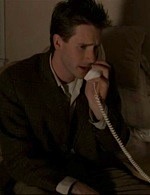 And this is where my memory grabs hold of the whole retro shtick. Y’see, there’s a great scene in Noah Baumbach’s Kicking & Screaming (no, not that K&S) where Grover (no, not that Grover) is lounging awkwardly in a dorm room party, whilst in the background the Liz Phair cover of the Splits theme from the alternative band Saturday Morning compilation plays. Or so I thought, when I first watched the film. It turns out that they were actually listening to Bob Marley’s “Buffalo Soldier“, something I would have caught, were I just a little more hip.
But that was okay. I still liked the subtext of the scene. It’s one of those odd pop culture connections that take place in one’s head out of almost sheer desperation when one is wallflowering at a party. “Buffalo Soldier” reminds Grover of the Banana Splits which in turn makes him wonder about the Josie and the Pussycats episode that he calls up Max about. It’s not delineated, step-by-step, but it makes sense. An audience member can fill in the blanks.
Or so I thought. Yesterday Mr. Wheeler linked to the Beeb’s follow-up article that analyzes the similarities between “Buffalo Soldier” and “The Tra La La song” and finds them lacking in key essential similarity. I think this is like the case of the Nokia ringtone and it’s origin from “Gran Vals“, by Francisco Tarrega… there is a key tonal difference between the two (fast forward two minutes in), but one would never dispute the obvious commonalities.
Related Links:
+ Kicking and Screaming: DVD by the Criterion Collection
+ Kicking and Screaming: Analysis by Chronological Snobbery
+ Liz Phair, “The Tra La La song“, Saturday Morning
Funny Face, Funny Books
I’m not going to work more often than I can help it, so my exposure to my traditional Audrey Hepburn calendar is considerably less than daily. I’ve purchased a number of these calendars over the years — although this is the first year I’ve noticed that the name Audrey Hepburn is followed by a ™ symbol… has the estate of the late Ms. Hepburn really trademarked her likeness in this age of mass copyright infringement? — and enjoy the mild cheesiness of the almost total absence of cheesecake in the images.
I watch for repetition of images over the years, and notice that certain promotional headshots tend to make frequent reappearances. This is a pity. With appearances in twenty-nine films, surely Audrey Hepburn™ LLC must be able to license stills from her films or photos from her magazine appearances. I mean, it’s probably not possible to reproduce stuff by, say, Philippe Halsman, but there’s only some many years that I can stare for a month at that particular black and white coquette by Bud Fraker from 1953. The recent “Remembering Audrey” by Bob Willoughby for Life magazine had a number of photos that were new to me, so we shouldn’t be hitting the end of variety just yet.
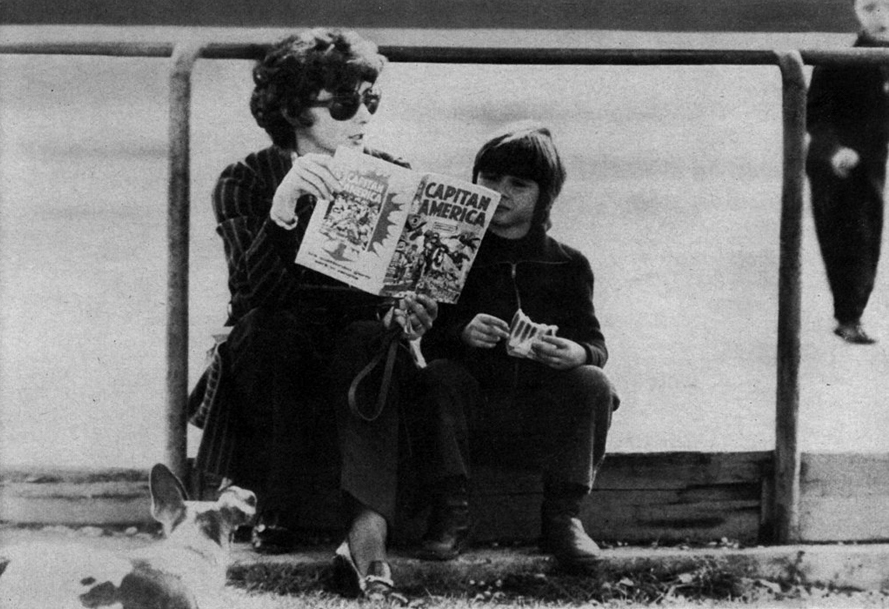
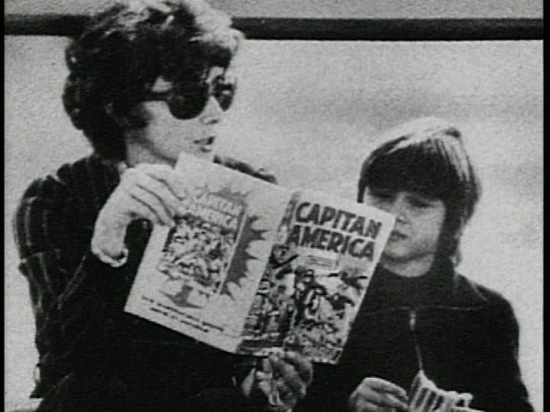
So I am particularly pleased to submit the following for consideration: Audrey reading a reprint album of Captain America with her son. Audrey and Comics: two great obsessionsinterests in my life, together in one grainy image. Now that’s something I’d like to see for a month in some future wall-hanging. May I suggest November 2009?
Dedicated to Rahul Kolhatkar
I don’t have a particular thing for George Clooney. I like him, but I would like any person who is cast in the role as this generation’s Cary Grant, because I adore Cary Grant. More people should be trying and vying and jockeying for the position of this generation’s Cary Grant, as far as I’m concerned, but if we’re only going to have one, then, by god, I’m going to have some low level adulation for him.
But I respect any man who is successful and who is able to balance glamour and self-depreciation. It’s a winning strategy, as it leads me to infer humanism and frailty upon a person who has clearly had to, at some point, step over the bodies of others in order to reach the vaunted levels of success that make anyone a household name. And it’s hard not to like anyone who had something to do with Out of Sight, a masterful piece of charm.
But yeah, it’s not as as George is the final part of my Five and Switch. But because he prefigures prominently in other people’s estimation, I was interested in his profile in the New Yorker. And I was glad I read all ten pages of it, because I now feel closer to George Clooney than I have any other celebrity in my life:
“He hit his head on a concrete floor; not long afterward, cerebrospinal fluid began to leak out of his nose.”
Anyone who’s heard me tell “the cranial fluid story” will understand.
Academia
So the 80th annual Oscar award ceremony — excuse me, “Oscar®” award — starts in about a half hour, and many weeks ago I planned on writing about my experiences watching the five contenders for the Best Picture nominee, and I suppose if I’m going to write something, I better do it quick.
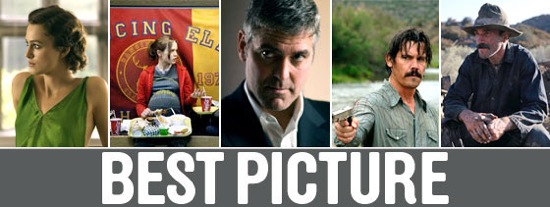
In addition to watching all the Best Picture nominees and writing about them, I had this whole plan about creating an image for the piece that was a collage of all the ticket stubs from the films. I saw the five nominees at four different cinemas, and I always save my ticket stubs, so I thought it might look kinda neat, plus adding a sense of verisimilitude to my “expertise” on the matter. I couldn’t find but two of the tickets, though, looking around the apartment for the last fifteen minutes. Found the stub from National Treasure: Book of Secrets, though! That’s a keepsake and no mistake! Sigh… Anyway, so in lieu of my original plan, I have simply stolen the above image from New York Magazine’s entertainment column, “The Vulture”, who provide me with daily snark and excellent coverage of all things spangly.
I don’t watch the Oscars® anymore. I can’t recall when I stopped, precisely, I remember being outraged at an interview that Danny Elfman gave wherein he stated that he’d never win an Academy Award, because the snobs on the original soundtrack section of the Academy looked down upon his rock ‘n’ roll background and would never see him so nominated. (Although, now that his compositions no longer fill me with joy, I note that he’s listed as a member of the Academy on the official press release.) I remember watching the Oscars in early 1995 and loving Dave Letterman’s schtick, and bemoaning the fact that I didn’t record the “Do you want to buy a monkey?” montage. So I was confused when he recieved such bad press and aghast that Forrest Gump won some many accolades. Somewhere between the 1994 and 1998 Oscars, I gave up on the whole shebang, and instead started stumping for a system that ignored the word “best”, and instead concentrated upon a merit-based system of awards. If there was a good enough film to be worthy of recognition, it would be celebrated, but one wouldn’t choose between five just because millions and millions of dollars had been spent on three hundred-odd movies over the course of a calendar year, and they needed some spectacle to make it seem justifiable.
It’s 7:03pm EST now, so I’ve run over my allotted time in which to generate some comment before the program starts. Suffice it to say that this is the first year in a considerable amount of time where I’ve felt like the nominations left me spoiled for choice, and all five films were of distinct voice and a high caliber of storytelling. Not all five deserve “Best” picture status, but I would be glad if any of them one. Yes, even if Jason Reitman, Skidmore College’s hottest dropout, vaults still further into a realm of success I couldn’t hope to grasp or even glimpse. Juno is too slight, and too immature in its storytelling to really stand next to the complexities of the other four, but I like the fact that it’s there.
Anyway, it has been my assessment for some time that movies tend to win, not on their actual content, but on the psychic bulk of baggage that comes along with the film. Philadelphia wins for making people feel guilty, and Gump wins for making people feel good. Martin Scorcese wins because he’s been snubbed in the past, and actors win for previous parts that were amazing, but not sufficiently showy. On these criteria, therefore, I predict that the Coen Brothers will win for their unrecognized body of work, which shadows and hovers around Old Country with palpable force. None of the other films has sufficient behind-the-scenes personality to win for the best film, as Daniel Day Lewis is the only comparable presence in the running. But Daniel Day Lewis is no Paul Thomas Anderson, and while the producers may collect the Best Picture award, it always seems like they are a second — but more important — Best Director award.
In closing, here’s a picture of Ellen Page not smoking a pipe. Let’s see that hit count shoot up now!
Ring-A-Ding-Ding-Along With Me
Bits and bobs to begin being the beguine, if you take my meaning…
 + I’ve closed down The Brothel, an internet forum I’ve hosted since March of 2003. It was good fun, and good conversation. If you participated in it in any way, thanks for hanging out. I find that I miss it, and still have regular instances where I find I’m itching to go there and type out something. My hope is to start writing this stuff in letters again, like I used to. If I used to e-mail you a lot and don’t any longer, now would be a good time to hit me up again for my patented brand of twitchy correspondence.
+ Aileen regularly gives her fellow statemates a bit of a going over for complaining about the weather. And she’s got a point. Complaining about the weather is a particularly ineffectual use of one’s vitriol, whether one is bitching about the unpredictability of the daily expression of the climate, or whether one is moaning about the totally predictable display of living someplace where there are seasons. And even if one had gotten used to the past three years of warmer winters, brown Christmases, and less frequent shoveling, one really can’t find much in the way of forensic ground to complain about a return to normalcy.
That said, the guy who who plows my driveway got stuck in the snow and ice that had accumulated there over the past few days. It’s a hoary old joke, but yeah. The plow. Got stuck. In the snow. I think it’s time to call a moratorium on precipitation for a little while, okay, Old Man Weather?
+ My mother has just called me to recommend that I go see Lars and the Real Girl, the heartfelt tale of one man’s relationship with his Real Doll. I can’t tell if this is because she thought it was weird and funny, or is that she’s given up on my ever getting married and has switched to a twisted new tactic.
+ There are a couple of films that I watch annually. While Mark Kermode and Simon Mayo recently debated the best Christmas movie of all time (Die Hard all the way, baby!), I find myself deviating from their list and regularly rewatching Billy Wilder’s The Apartment as my sole piece of personal seasonal entertainment. Bridging the gap between Christmas and New Year’s Eve, it’s my touchstone of a certain kind of solitary melancholy.
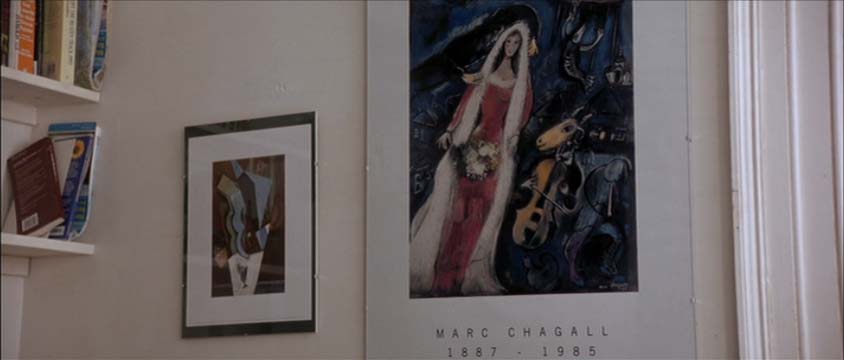
This year, upon rewatching, I was suddenly struck by the presence of a Chagall painting in the background in one scene.
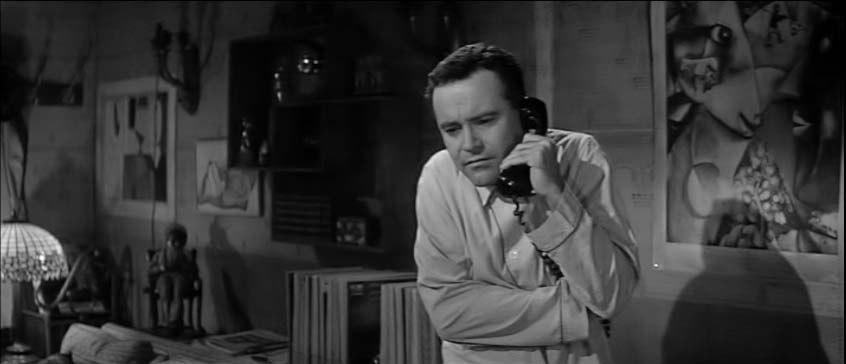
How odd, I thought, that this Chagall would be used as a print in both The Apartment and years later in Notting Hill. It was an odd sort of subtle tribute. Or maybe it was because the rights to displaying the image were held by the studio. Or something else. In any case, it was an interesting coincidence, and the sort of blog post that Glenn Kenny would have been proud of. I scampered off to grab a screencap from both films, only to find out that it wasn’t the same painting at all.
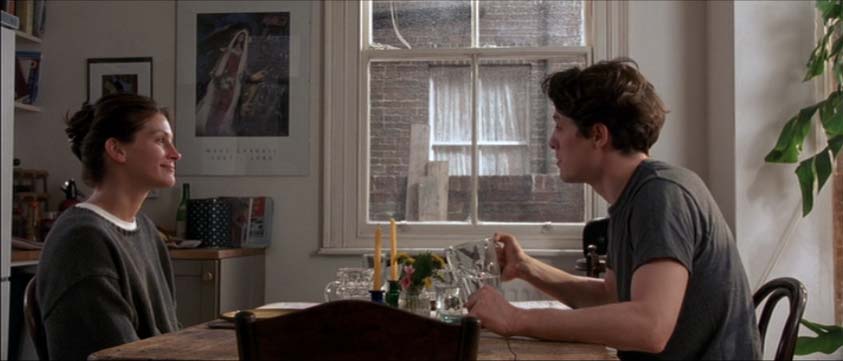
I haven’t the faintest idea where else I’ve seen the painting in The Apartment, then. I had a suspicion that it was in the Chagall exhibit at the Kunstmuseum Heidenheim, but a review of the programme indicates otherwise.
So I got nothin’. Instead, I’ll merely quote the endearing Richard Curtis dialogue from Notting Hill:
ANNA:
I can't believe you have
that picture on your wall.
WILLIAM:
You like Chagall?
ANNA:
I do. It feels like how
being in love should be.
Floating through a dark blue sky.
WILLIAM:
With a goat playing the violin.
ANNA:
Yes... happiness isn't happiness
without a violin-playing goat.
 RSS feed
 smartovercoat.com