The Studio Where It Happened
I tried to learn to play upright jazz bass between 2000 and 2004. I’d been enjoying doing a vocal impression of a plucked upright bass for several years beforehand — probably ever since my voice dropped and I re-listened to Floyd Pepper performing Johnny Cymbal’s “Mr. Bass Man” — but I did think that it might be more impressive to actually be able to play the instrument instead of miming it. However, to get good at something one needs to practice, and at that particular window of my life, between holding down a job and a half, trying to build up my portfolio as a future comic book artist, and transforming into someone who would be defined as “extremely online“, it was hard to find the time to play a bass badly often enough that I would eventually get slightly better. So when I went to grad school to learn librarianing, my bass went into storage, as it was too unwieldy to fit into my two-room, $480-a-month studio apartment. When I graduated and acquired a job and an apartment with two and a half more rooms in it, my bass returned, but in the less active role of now being referred to as “my most beautiful and expensive piece of furniture.”
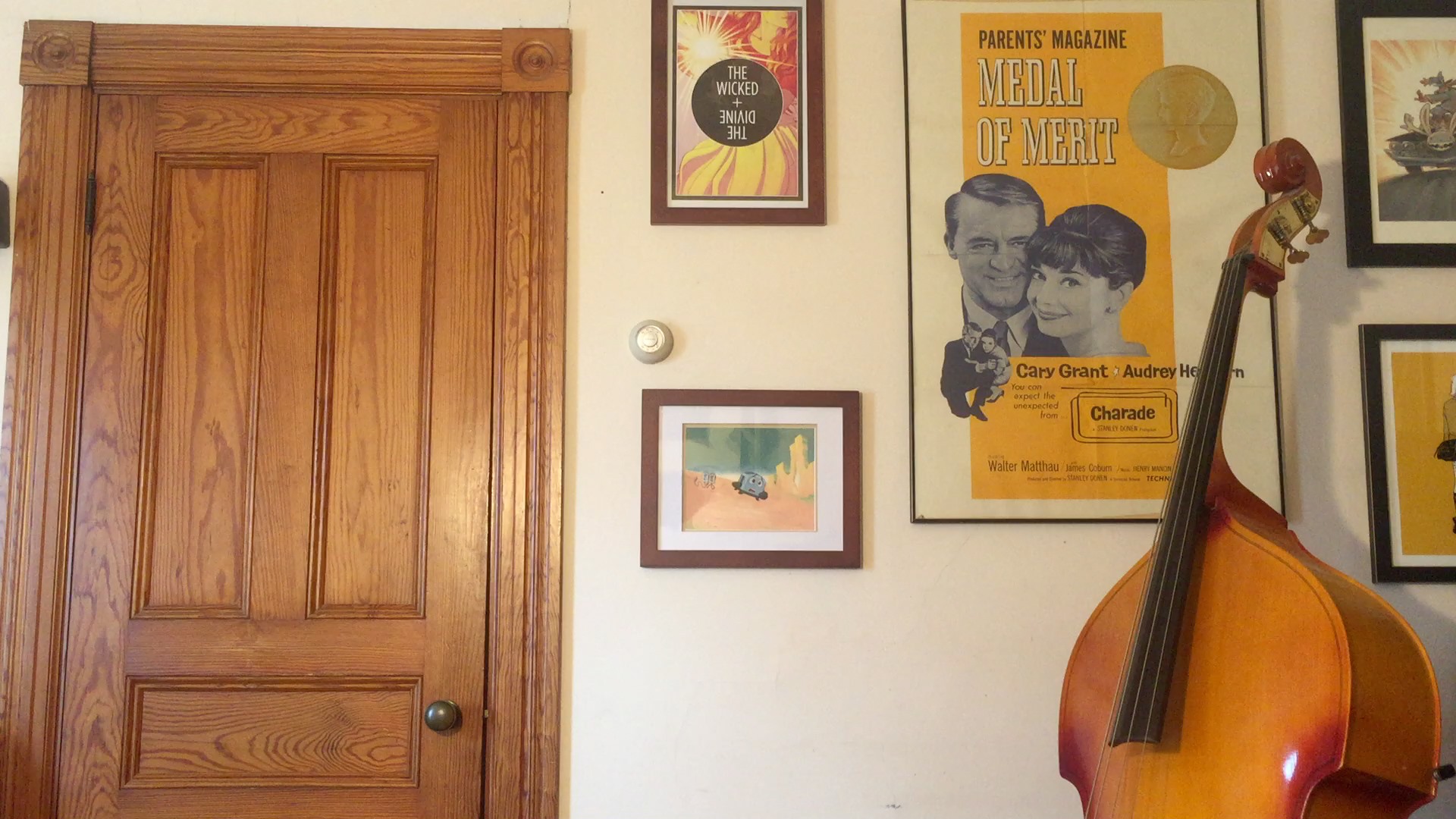
I carefully positioned it within the apartment where the sun would hit the thick lacquer finish, and the room would glow with it’s golden warmth. But I didn’t play anymore. While I had tried to immerse myself in the world of jazz bassists, this mostly consisted of being able to namedrop “Paul Chambers.”
Despite these limitations, somewhere around 2006 I’d learned about Esperanza Spalding. Considering she’d graduated from Berklee in 2005, I’m not quite sure how this is possible, but a careful Facebook search reveals my speculating whether my wandering around Simmons and the Fenway could possibly result in bumping into her, since I miiiiight have heard a rumor that she’d already been invited back to Berklee to lead seminars since she had already ascended to being generally thought of as a godhead. Most of this isn’t easy to prove, and sounds mostly like a wannabe trying to claim he was streets ahead of the fandom, but since the Boston Herald tells me that a huge banner with her likeness was being displayed on the side of a Boston building somewhere close to her senior year, I maintain that it’s possible her name was in the aether, even to poseurs like me.
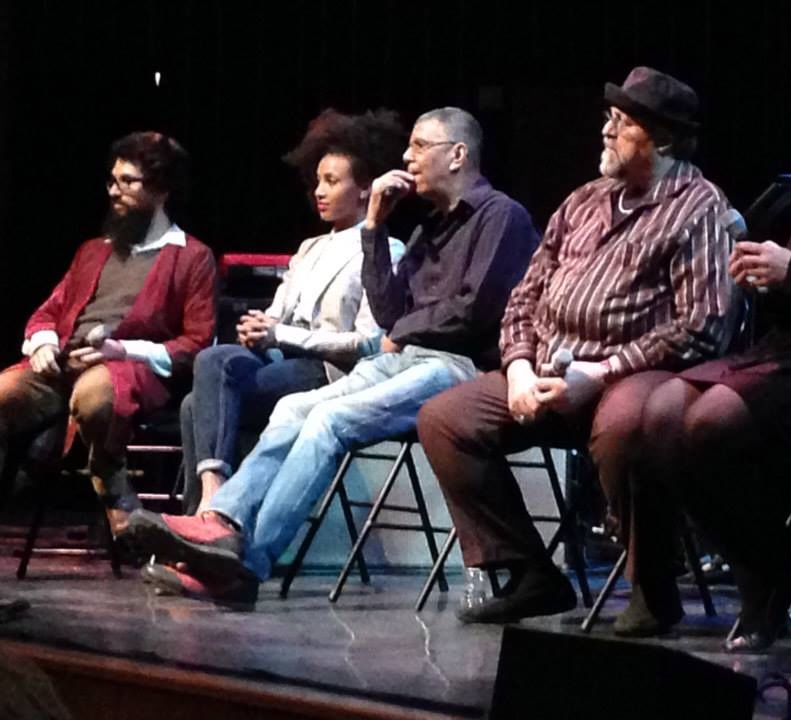
That said, what Spalding became best known for just a few years later, was being unheard of. When she was nominated in the Best New Artist category for the 2011 Grammys, I was naturally in her corner despite doubting she had a whelk’s chance in a supernova of victory. And then I was gleefully, hilariously glad when she won in the face of seemingly overwhelming Belieber Fever. (A moment that continues to reward both taste and schadenfreude.) I relished every moment of stolen valor of having already been her fan during the subsequent deluge of “Who Is Esperanza Spalding?” articles and then during the subsequent further honors she accrued. After missing an victory lap appearance by her in Boston at the Sculler’s Jazz Club due to weather later that year, I was finally able to catch her a couple years later as part of the jazz supergroup The Spring Quartet at Dartmouth’s The Hop.
So when a mailing-list email arrived in my inbox telling me about a creative endeavor she was about to embark upon — a seventy-seven hour writing and recording session resulting in 7,777 copies of the album, never to be re-released — I was well in the mindset, even yea those years later, that I was part of a rarefied group of fans, and it was my duty as a persistent crowdfunder to support this new adventure. The particular hook that the album would come with a piece of the draft lyrics that were going to be written in the studio over the course of the session — a literal snippet of raw creativity — was, again, a piece of reflected glory that was the ideal enticement for my particular breed of fandom: a failed creative who craved totems, talismans, and relics of success from those who were doing the hard work of both actually practicing their instruments and using them as the means of connecting to others in the world. I placed my order — for the vinyl, not the CD, despite not owning a functioning record player, because another aspect of being a wannabe originalist is to experience art through hipster media — and settled in for the eventual recording.
I can no longer recall if I was actively aware that I missed or would miss the livestream of the creative process. The stream started on my first day back at work after a whirlwind visit to Sacramento for the wedding of a dear friend (who had been really, really, enviously good at obsessively practicing an instrument when he was in grad school), and I have no record nor recollection of if I was too fried or too busy to carve out some time over the next three days to pop onto Facebook and watch Ms Spalding create Exposure in real time. But when the physical record did show up, despite my thrill at its existence, I carelessly left it on my kitchen table, where the same warm sun that lit up my living room with the amber tones resonating from my bass repeatedly heated the vinyl so that it warped into a undulating curve like a fairground ride. I didn’t actually know this had happened for a couple years, because it took until I finally invested in a working turntable for my stereo stack for me to pull Exposure out of its sleeve in order to experience its mystery and the majesty for the first time… and instantly (belatedly, but instantly) realized that something was wrong. I experienced the sickening understanding that while I had in my hand an original piece of a marathon creative session that fewer than eight thousand other people on the planet had access to, it was simultaneously beyond my reach. I watched the sinuous humps of the record bounce the needle off of its surface, like a spaceship slingshotting around a gravity well, and realized I was unable to unlock its secrets.

So when Spalding, on her Instagram account, announced this week that there was going to be a seven-year anniversary encore stream of the original streamed recording session, I literally set an alarm as well as writing the time down on my hand so as not to miss it this time. Streaming this afternoon and evening has been a strange and wonderful experience. I often muse about the many and varied ways in which musicians go to the studio and record music, the way in which some albums are discovered and manifested collaboratively. Sometimes this literally means that musicians need to re-learn their own songs, not just because the process of creating them was a wave of moment-to-moment processing, but also because the tools used in a studio to create depth and richness and layers may be incompatible with the kind of musicianship that’s easy to tour small venues and clubs with. And so the contents of an album frequently need to be reverse engineered and reconstructed into a form that the putative creator can actually perform. A strange thing to consider in our collective auteur-focused mindset, but a genuinely common phenomenon.
So watching this particular creation experience has been fascinating. I don’t, obviously, assume its representative of most or any other recording sessions in the broad strokes, but it’s difficult not to want to find a degree of universality in the execution of expertise of the session musicians, engineers, and creators. And the process of inspiration to actualization has been particularly compelling. Three and a half hours into the stream, Spalding had wrapped the initial shaping and structuring of the first two songs of the session — one that began with warbling glossolalia that had the bass laid underneath it, and the second that began, in instinctive contrast, with the bass first as the armature that the song coalesced around. These two songs were fashioned as first drafts with the knowledge that Andrew Bird was coming to the studio, and that they wanted to have the third song be a collaboration focused on his time and contributions. For more than four hours Spalding and Bird then danced around each other, establishing trills of the soprano violin strings — and Bird’s trademark piercing whistle — in a skipping, lilting contrast to the deep bounce of the bass’ strings.
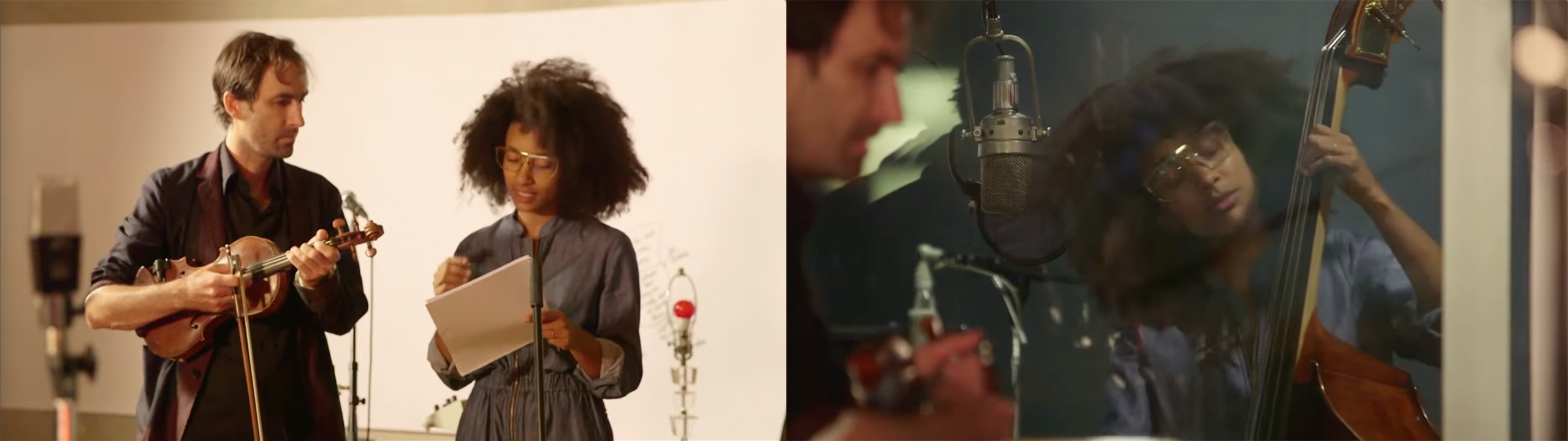
(A moment of betrayal: it was particularly interesting — to me — to hear Bird’s melodic tendencies and voice emerge in contrast to the minor keys and deferred musical resolutions that are more part of Spalding’s jazz vocabulary. When she would redirect back to her preferred style, he would defer — almost instantly, so far as I’ve observed — to her voice and her primacy in the album, and yet I found myself smiling at how my brain tugged at the idea that I think I might have preferred the Sliding Doors hypothetical existence of Andrew Bird’s Exposure to the final record.)
But while I have been sad for years at not being able to hear the slice of history I’d ordered back in 2017, I find myself deeply, strangely glad that I’m not familiar with the songs from the album as I listen to the circuitous meanderings of the musicians finding the paths of the first three songs of the session. If I knew these songs, I think I’d be driven to distraction by the stop-start of the process of hearing Spalding noodle over a couple bars of music, prodding at the progression of two or three notes until she feels at peace both with the sequence and the pitch. I suspect it would be like listening to a skipping record, to a song that I wish would move on to its familiar patterns, but instead is in a rut, hesitating and regressing. After spending hours tonight with the exploration and rehearsal rippling away in the background, I think that when I eventually do somehow hear these finished songs, the ambient repetition will make them familiar and comforting, and the album will instantly be something that clicks within me with a sense of coming home.
My brother will regularly say that his favorite podcast is Twelve-Hour Day, not just because it features Connor Ratliff, the comedian who inspired him to pursue his own dreams of professional comedy, but also because of the intimacy of the ambient sounds of real life that are part of the each peripatetic episode. I’m finding something parallel while listening to this re-broadcast: I’m obviously enjoying the peeks into the creative and technical processes that it affords me, but I’m also really enjoying the casual, incidental moments captured: taking a beat to drinking tea and move the set from room to room within the studio, the scritching sound of scribbling and crossing out lyrics on the giant pieces of paper hung throughout the space, the necessity of the time it takes dragging snippets of recorded sound to a different track and get the alignment and beat count right. All of these moments and more are generally filling the studio and my computer speakers and monitor with extra bits of reality that went into producing this particular moment of recorded time. I feel lucky to have a chance to see and understand pieces of what I missed the first time, and to extrapolate what I can about this creative process — both as part of a greater canvas and in its specificity.
And I’m pleased in a competitive, 2011 Grammys fashion that the seventy-seven hours of Spalding’s studio time kind of kicks Ratliff and Amato’s measly twelve-hour recording sessions into a cocked hat.

The chat of the rebroadcast YouTube started off at about sixty watchers during the opening few moments, and was at 77 viewers right before Esperanza used her remote control to start the 77-hour countdown clock. Since then, the viewship has — whenever I’ve checked in on it — seemed to stay consistently in the middle to high two-hundreds. And the conversation, as people have wandered in and out, has repeatedly focused on how people would love for this feed to remain available. The fact that it was successfully captured at all is lucky — the live Facebook feed was deleted immediately after the conclusion of the broadcast, and about 7% of the original footage was lost and won’t be available during this reconstructed re-stream. YouTube is required to chunk it up into twelve-hour segments, apparently — so we’ll be able to directly compare the stream to the entirely of Twelve-Hour Day’s output thus far — but there has been some chatter that the streams will not remain available after the anniversary has come to a close. If that’s the case, then you have 69-hours from when I’m typing these final sentences to enjoy your own little window into a particular example of how the musical sausage gets made. I thoroughly recommend it.
Related Links:
+ NPR: A 2010 appearance in the Tiny Desk studios was then republished right before Spalding’s initial Grammy victory. Also, I should check out her visit with Marian McPartland.
+ LennyLetter: An interview with Spalding from 2018, circling her “Emily” identity.
+ ArtsEmerson: the holding page and embedded program for …(Iphigenia), the opera Spalding composed with Wayne Shorter and performed in Boston.
 RSS feed
 smartovercoat.com
Benjamin Russell said,
29 January, 2025 at 10:24 am
NPR has just published a new article in conjunction with Spalding’s most recent Grammy nomination, this time for her collaboration with Milton Nascimento. Having just missed her playing in New Hampshire (due to some ticket prices I couldn’t quite muster up the enthusiasm to equal), I should really give this newest celebration a spin.