Oxford English-ish Dictionary
I understand that the Oxford English Dictionary does not consider itself to be a prescriptive dictionary. Their mission, to chronicle the important textual usage of words and how that contributes to a wealth of connotation, is a noble one and it provides an invaluable resource. However, the massive undertaking that used to be involved in the updating of a dictionary always made it a prescriptive tool, regardless of its intent. By detailing usage, the OED codified it and validated it, because people treat any dictionary as a usage guide, as opposed to a usage catalogue.
And now that chronicling usage has become simpler, words that are not so much “words” as they are sloppy reductions and adaptations of of established morphemes are being included in the Online Oxford English Dictionary. People worry about the effect instant messaging will have upon communication and upon the writing skills of the current generation of students. Worry more about the student that points with a stylus at the screen of a wireless ThinkPad and says, “Screw ‘formal writing’, granddad… Your precious OED says its a word right there. And if the OED lists it as a word, you can’t mark it wrong on my paper!”
Don’t get me wrong, I think a dictionary should enumerate slang, I just think it should be clearly marked as such. If you’re going to integrate entries, I at least want obvious indications of some sort of verbal caste system.
Usually there’s a minor media kerfuffle about new words included in the dictionary, but updated entries for an online dictionaries — even the OED — must be small potatoes these days when the New York Times (which, I feel I should point out, snooty word freaks would tell one should be properly called the “New York Times“, regardless of what appears on the banner) uses the opening sentence “When you sculpture heads…” instead of “sculpt heads”. Or perhaps I’m off base. Anyway, when the Times can’t be counted upon to fact-check stories, uphold its position as the fifth estate, or even maintain the standardization of the English language, then the following excerpted list shouldn’t seem too surprising:
The following completely new entries were added to OED Online on 9 June 2005:
abdominizer, n.
alley-oop, adv., int., a., and n.
arsey, a.
beered-up, a.
bogart, v.
boyf, n.
brown dwarf, n.
buttlegger, n.
buttlegging, n.
carb, n.2
clip art, n.
conspiracism, n.
co-pay, n.
dagnabbit, int.
deconflict, v.
dequeue, v.
derivatization, n.
derivatize, v.
derivatized, a.
dickwad, n.
disconnect, n.
downwinder, n.
dumpster-dive, v.
emo, n.
emo-core, n.
ergogenic, a.
fabbo, a. (and int.)
filmize, v.
FOAF, n.
foo fighter, n.
fubar, v.
girlf, n.
grammatology, n.
he-said-she-said, a. and n.
in-box, n. and a.
ka-ching, n. and int.
ka-ching, v.
skank, v.
techno-shaman, n.
tricknology, n.
versioning, n.
vidiot, n.
wuss, n.2
wussy, n. and a.
zombied, a.
zombification, n.
zombified, a.
zombify, v.
For a complete list of changes and updates, download this 12-page PDF (120 KB). It’s an interesting list: very British in places, and some of the new entries seem head-scratchingly late in coming. Why has “tikka masala” been absent all this time? Still, I wish that a great many of the brand-new entries had been included as variations and sub-entries instead of being given the full-word status of having their own little respective (and — to make my point again — inadvertantly prescriptive) articles.
Eyes Only
Despite my love of John le Carré novels, I have found that the wider realms of British Espionage haven’t really lit my fire. Recently, even though I had been told that his early spy stuff is generally considered to be the weakest of his output, I tried and failed to slog through Graham Greene’s The Human Factor, which wasn’t bad but wasn’t moving at a sufficient clip to retain my allegiance. But after watching a couple of Michael Caine’s “Harry Palmer” films and recalling that for years I’d been listening to interviews with Hugh Laurie where he sung the praises of Len Deighton, I decided that it was probably time to see why they were popularly considered to be influential and gripping.
And I have not found out. It is my habit to read books that were the source for films I’ve enjoyed. I enjoy being able to not have to pay any attention to the movement of the plot, and concentrate solely on the writing. I already know what’s going to happen — with the obvious exceptions that a film’s fidelity to a novel is loose at best — and so can instead look at the craftmanship, at the tricks of narrative and perception, at the doling out of information. So I decided to begin my Deighton investigation with The Ipcress File. And what surprised me was that while Mr. Caine had played the main character with a curious blandness, with a sloping simplicity that made his performance intriguing and compelling, the same lack of passion, verve, or motive force in the character on the page made him a sheer bore. Watching him play characters one off the other, double deal, and lie lacked the ambling off-handedness of Caine’s portrayal and simply seemed… empty. Without being able to read his motivations, there was no compulsion on the part of this reader to follow him along and eventually discover what his end game was. It seemed too blandly happenstance to actually have an end game in mind.
I am about to give Deighton a second try, though, based not upon my hopes for his writitng or the clever plots detailed on the cover blurbs. No, but because of a clever piece of gimickry discovered in a vintage copy of An Expensive Place to Die, the first American edition, as printed in 1967. On the inside front flap there is a TOP SECRET document folder, containing miniature facsimilies of fictional memoranda of documents apprently key to the story events contained within.
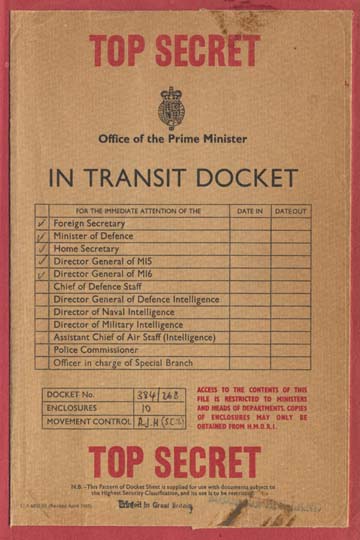
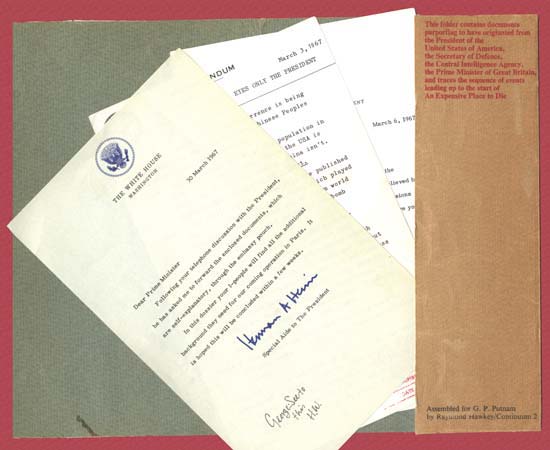
Verisimilitude, or attempts thereunto, will almost always pique my interest. And so I am giving Len Deighton a second shot. For those interested, I have made a 1 MB .PDF scan of the dossier available for download. Perhaps it will intrigue you sufficiently as well.
Lastly, the docket folder claims that there are ten items enclosed, but my public library edition only has three documents remaining. Anyone with copies of the other seven pages, should they actually exist, is encouraged to share them with me.
Is it real? Or is is the news?
I’m not usually a fan of shlock tabloids. I have friends who were very excited about Batboy: The Musical, based upon the popular reoccurring character in the Weekly World News, and young-adult librarians have considered putting tabloids in periodical sections as an “lite” option for reluctant readers. However, in my opinion, The National Enquirer, The Globe, and the like are filled with disturbing levels of invasion into the lives of celebrities and as well as content that is borderline repellant in its overt titilation.
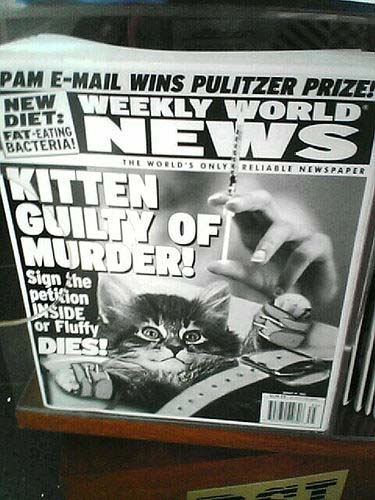
So it is with some degree of surprise that I found the cover this the current edition of the Weekly World News to be incredibly inventive. The “Or the kitten DIES!” idea is a classic National Lampoon joke, but the graphic is well-done in the traditional part-drawing, part-manipulated-photo manner. The (partially obscured) headline about SPAM is hilarious, and I’d never really noticed the banner motto before. It’s all quite self-aware. Perhaps it really could be used by librarians in media literacy curriculum.
Cackles of Compassion Lite
For those of you who miss the ability to listen to Ben, Ken, and Dimitri’s revolutionarily self-indulgent college radio show as recreated through the magic of Live365.com, I have a partial solution: Last.fm and Audioscrobbler.com.
 Audioscrobbler is plug-in that allows you to send any music that you play on your computer to a user account. This user account is hosted by Last.fm, which synchs your data with a fairly vast collection of licensed music, which allows you to listen to a streaming audio radio station that is based upon similar music to what you’ve played on your personal computer. One can also listen to the music favoured by one’s “musical neighbors”, people who have listening profiles similar to your own.
One only gets a month of free personal radio, which begins immediately after creating a user account. Listening to one’s neighbors is always free, but less likely to simply be music one likes. If one wants to be able to listen to one’s own musical tastes wherever one has a computer and a sufficiently speedy ‘net connection, one has to pay a “minimum suggested donation” of twelve dollars for a year’s subscription. Cheaper than National Public Radio.
So what’s the point? Signing up with Last.fm and listing me as a friend means that you can listen to my personal station, which is essentially like listening to Big Cackles of Compassion. The bands that Last.fm has in their library is quite compatible with my tastes: they have the eels, Suzanne Vega, Stacey Kent, The Smiths, Belle & Sebastian, Propellerheads, tAtU (in Russian!), The Cure, Frou Frou, Ani DiFranco, The Shins, The Who… If only they had a little Tom Lehrer and some more Stephen Sondheim, it could be just like the snippets of music that Dimitri and I would play between our interminable on-air conversation.
Also, how can you go wrong with an online service that promises you a pony when you subscribe?
Virtual Doubt
So… I may well be paranoid or seeing connections where there are none, but I’m reasonably certain that an innocent but unexpected visit to a friend may have caused her to switch her IM username and close her ‘blog. It is at least certain that she did these things within a few hours of seeing me, and I couldn’t help but connect the dots. Otherwise I’d have said that the conversation between us was short and innocuous.
Anyway, with no non-confrontational way to communicate with her, it’s a little difficult to confirm or deny any suspicions on my part. Which leaves my suspicions as, well, suspicious… questionable. Not exactly sure how I should feel about that. Ah, well, just one more thing to bury.
Hyrbid Cars, part 3
Now that I have archives happily built into the design of the site, I now feel like I can begin having running series of related comments. In that spirit, I had a couple of earlier posts about Hybrid cars that an article in the Keene Sentinel reminded me of this morning.
But now, hybrid technology seems to be heading the way of earlier technologies such as four valves per cylinder and variable valve timing. Those technologies can also be used to improve fuel efficiency, but in many instances they instead became another way of building cars with greater power and faster acceleration.
Manufacturers have been downsizing the gasoline engines in some of their hybrids only a little or not at all. And some are adding the electric motor essentially as a “green turbocharger,” as Consumer Reports magazine puts it.
Consider Honda. The company has two older-style hybrids — the two-passenger Insight, which the EPA says can get 66 miles per gallon on the highway, and the five-passenger Civic, which can get 51. The EPA estimates that the 2005 Honda Accord Hybrid gets just 37 miles per gallon, compared to 30 for the non-hybrid version on which it is based. According to Consumer Reports, which performs what it says are more accurate mileage tests, the actual difference is even smaller: The hybrid averages only about two miles per gallon better than the standard Accord.
More in link.
Charade for Free
While reading through a Wikipedia entry on Frank Sinatra, trying to clearly establish which came first, his film career or his wide renown as a singer (it seems he began as a singer but didn’t catapult into chanteur status until after he began appearing in movies), I happened upon an anecdote about the film Suddenly, which was reputedly watched by Lee Harvey Oswald just prior to his shooting of President John F. Kennedy. According to a biography of Sinatra, when he learned this, he had all prints of the film pulled from available distribution, and did not renew the copyright, thus allowing the film to fall into the public domain. A wikipedia link to a website that allows free downloads of lapsed public domain films led me to a link to a free download of Charade.
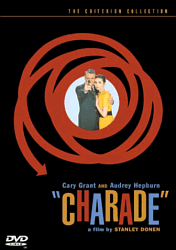 However, despite assertions to the contrary, I maintain my belief that Charade cannot actually be in the public domain. Now, I’m not a copyright lawyer, and I may well be wrong about this, but it seems quite clear to me that the various public domain DVD releases of Charade — and there are many — are not standing on firm legal ground, but taking advantage of a loophole that wouldn’t stand up under close scrutiny. Y’see, some prints of Charade were distributed without a notice of copyright. These prints are the ones that have been reproduced freely, as people are saying, “Hey! It didn’t say it was copyrighted on this print! How was I supposed to know?” The fact that it was copyrighted on other prints, and that intellectual property adheres to the content and not just the physical iterations of said content seems to be escaping most of these people. Plus, the fact that Universal Pictures made a remake of the film and re-released Charade on the DVD of said remake seems to indicate that they’re pretty sure they’re the copyright holders.
However, because of this loophole there are those that have thought the reproduction or adaptation of the contents of the intellectual property of Charade were fair game. So not only is there the official Universal remake, but there is also an indie-film adapation of the film. Robert Foreman has written and directed a film called Duplicity, written by Jack Cornish from “a 16th draft of a screenplay based on Charade”. Viewed at Cannes in 2004, it’s gone nowhere since. I’m hoping someone forgets to renew its copyright, so that I can legally download it and watch it for free, as I think that a film based on a screenplay based on a draft of a rewrite of a film based upon a novel based upon a screenplay based upon a short story in Redbook seems like something for which one might not want to pay good money.
Two last things. Firstly, while searching for some definitive answers to the public domain status of Charade, I stumbled upon some newsreel footage from 26 September, 1963 of “Mr. and Mrs. Robert Kennedy, Vice President Lyndon B. Johnson and his wife, and the President’s sister Mrs. Sergeant Shriver” attending the sneak preview of Charade at a benefit for the Stay-In-School Fund, an organization of which Mrs. JFK was honorary chair. Charade was released on December 6, 1963, and there was a rush to alter the prints so that the word “assassinated” would be dubbed over in the wake of the murder of President Kennedy. Why aren’t there more conspiracy theories surrounding this? VP Johnson clearly saw the original, pre-dubbed cut!
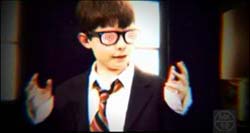 Secondly, I feel I should point out that Matt Fraction blogged about the free, downloadable public domain feature films aaaaages ago, but I never noticed that Charade was on the list. So, once again it becomes quite clear that I was born one day too early to actually be cool. Curses. However, the new video that Fraction’s animation and design studio produced for Guided By Voices is similar to their past works but a quantum step forward in terms of 3D incorporation and effect. Go watch it. I actually prefer the images with the sound off, but the camera strobe movement of the characters in the film make more sense when you realize that they’re in time with the song. Beautiful little thing, though, and the x-ray glasses effect is wonderful.
A Conspiracy of Cartographers
Rosencrantz: I don't believe in it anyway.
Guildenstern: What?
Rosencrantz: England.
Guildenstern: Just a conspiracy of cartographers, you mean?
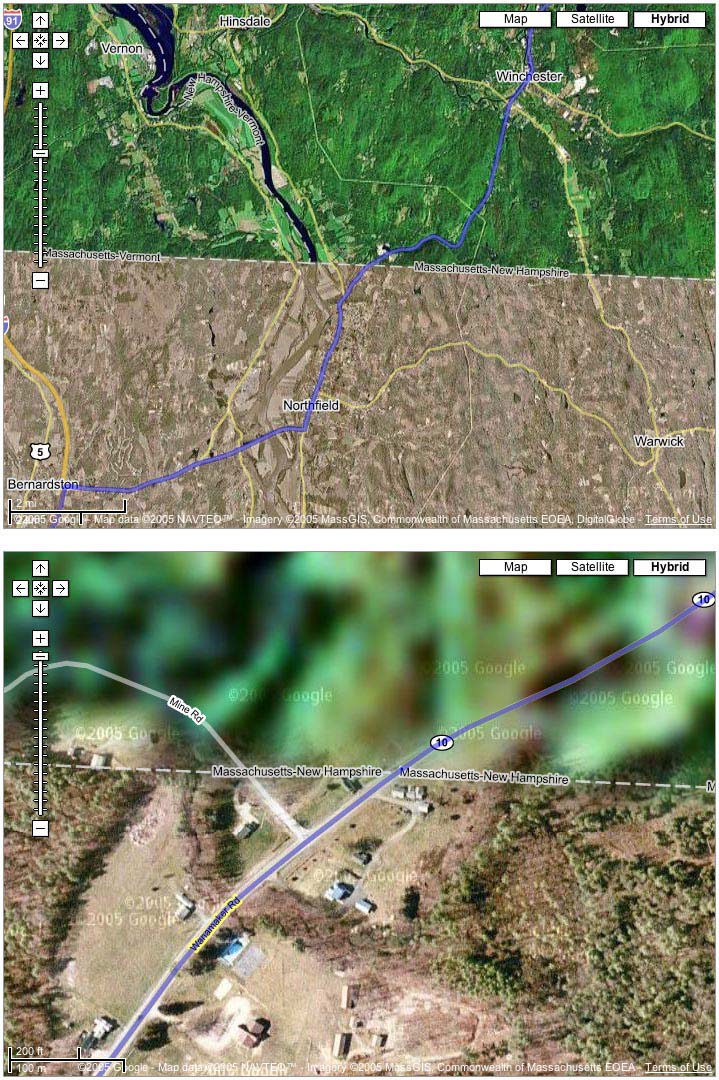
I apologize for the excessive map worship, but do consider this following snippet of page grab from Google Maps. To the left is a moderately wide-angle photograph of the border between Massachusetts and New Hampshire, along a route that I drive four times weekly. From this distance, they look moderately the same, except that New Hampshire looks significantly more verdant, as if its foliage is greener than its tax-laden commonwealthy neighbor.
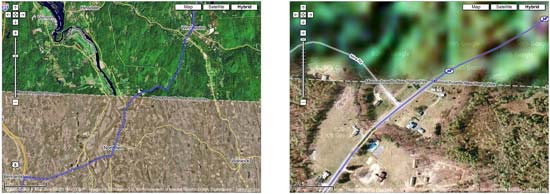
However, since the border between the two states is imaginary and not marked by a physical or weather barrier, it seems unlikely that Massachusetts’ trees should be in such dire need of water, especially when immediately next to their lush New Hampshire brethren. The image on the right brings understanding in to sharper focus by showing just how low-fidelity the zoomed-in sattelite images for New Hampshire are. Whoever is responsible for the NH aerial imagery, namely Digital Globe, clearly isn’t providing the level of resolution acheived by the neighboring MassGIS (Geographic Information System) in collaboration with the Commonwealth of Massachusetts Exectutive Office of Environmental Affairs. How sad to live in a state that looks down its nose at its southern sibling, and thinks so highly of its environmental efforts, only to discover that that Mass’ enviromental agencies are going to be able better track erosion, weather damage, deforestation, suburban sprawl, blight, and the like with sattelite technology.
Click on the above image for a larger demonstration of blurry, trippy, low-rez New Hampster.
You Will Go To The Moon
Google has installed a special site in “honor of the first manned Moon landing, which took place on July 20, 1969”, making this the amusingly non-standard 36th anniversary event.
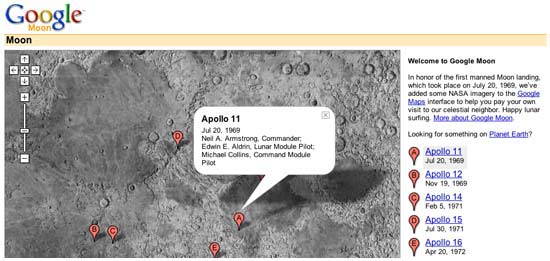
It’s part of the standard Google Maps feature, which combines directions and roadways and available satellite photos into a pretty smooth interface, with the expected Google speed to its interactivity. Once again, Google’s functionality is stealing my heart away from the plodding, methodical, reliable Yahoo.
And in part, it’s because Google’s cleverness and sense of humor inspires allegiance. Question three in the Help FAQ reads, “What happens if I try to zoom too close?”, with the following dare as an answer: “Well, you’ll have to go and find out, won’t you?”
And just to spoil it for you, if one delves too close to the surface of the moon, one discovers that it’s features are composed of the following: Read the rest of this entry »
Beat to the Blogged Punch
Before I left the apartment this morning, I briefly checked Delphi to see if anyone had posted anything to me, and noticed that The V had changed it’s name from whatever it was previously to “Panic on the Streets of London”. I assumed it was a reference to vast escapades in celebration of snaking the Olympics site from France and went on my way. However, in the midst of my morning commute to class, I heard on the news about the bombings and quickly reinterpreted what the title had signified.
 I stayed glued to the radio, wishing I could get to school so that I could find a computer and find out if everyone was okay. Renee Montaigne was clearly unprepared for a morning of this magnitude and did a game job, but she was a little shaky and tended to wander off on unfortunately discursive descriptions and recaps. And in the midst of all this breaking new and tense grasping at details, there came a promo for a later broadcast about the 25th anniversary of the release of the magnificent comedy film Airplane! (Yes, the exclamation point is part of the title.) And I thought, what a brilliant thing to link to on the old ‘blog.
So it was a great disappointment to discover later that Jimmy Johnson, writer and artist of Arlo and Janis had thought the same thing and beat me to the punch while I was still in the car.
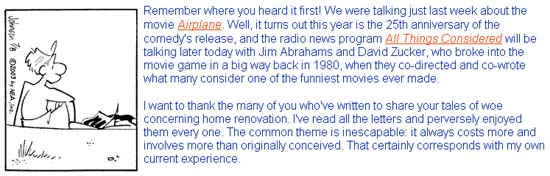
He even has the brazen temerity to celebrate that he posted first! Feh. I’m still blogging about it, obviously, but the excitement has left the building. Bizarrely enough, however, virtually the same story was broadcast five years prior for the 20th anniversary. And, incidentally, Airplane! made it on to the AFI’s Top 100 Movie Quotations, coming in at #79 with “I am serious… and don’t call me Shirley.” It’s no “Looks like I picked the wrong day to stop sniffing glue…”, but the fact that they made the list at all would be pretty cool if the AFI had any redeeming tastes whatsoever.
 RSS feed
 smartovercoat.com