SIX MONKEYS: Time Bandits (1981)
Previously: After Michael Palin’s father dies in a Caravaggio painting, he goes to the city and stumbles into the midst of several adventures and a poem. If Gilliam hadn’t already co-directed Holy Grail, this might have killed his career while establishing it…
For some reason, I always think that Brazil is Terry Gilliam’s second movie. I’m not sure why. But in my head he has the same narrative as Christopher Nolan: the first film is slight and underseen, basically an amateurish calling card, and then the second one has all the hallmarks that will underscore his auteur status for the rest of his career. And while that remains true regardless of whether Time Bandits or Brazil is his second offering to the movie gods, somehow it’s more impressive if it’s Brazil.
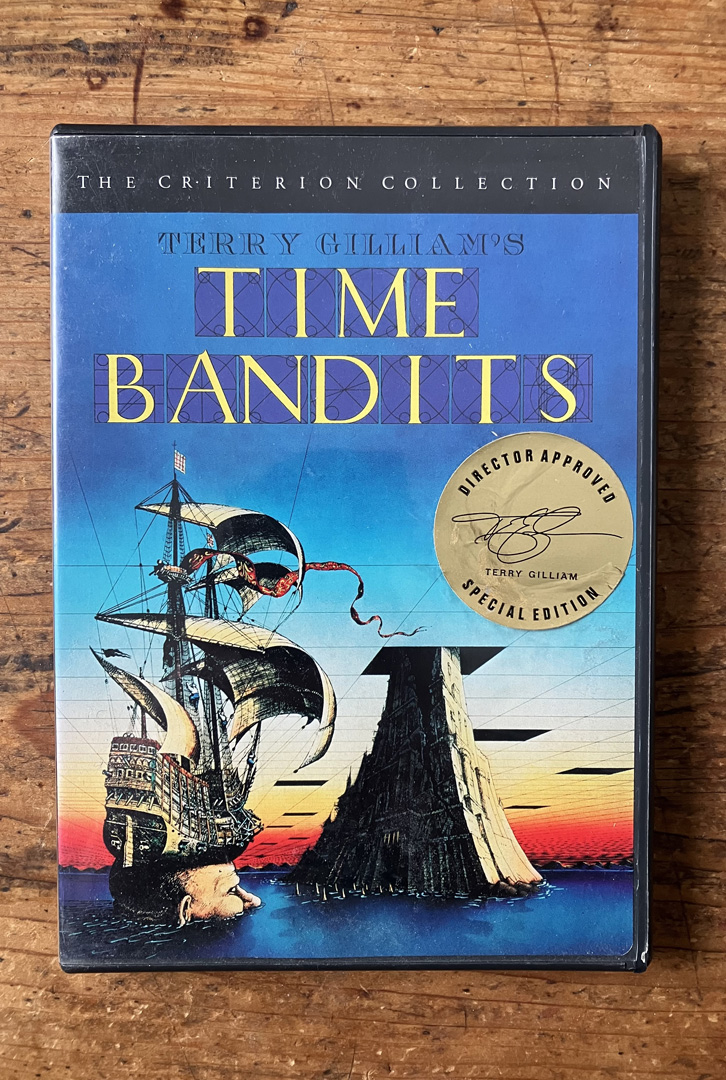
That said, I prefer Time Bandits. Is this in part because I saw it, in whole and in pieces, so many times as a child? Oh, almost certainly. There’s some powerful nostalgia baked into this film in three different ways. Actually, let’s just get into it:
Monkey 1 — Primary Primate: Because, as established in the introductory Six Monkeys post, I watched this so many times over at Geoff’s house, I don’t have a clear memory of watching it for the first time. What I have is a sense of how this movie fits in with other films of the time. In re-watching it, I can see details in the set-dressing of Kevin’s bedroom that helped make it feel real and helped establish the Proustian sensory detail that telescopes me back, Ratatouille-style, to the memories of my own childhood. Kevin’s dun-colored scratchy fake-wool blanket with the shiny polyester trim is absolutely a blanket that existed in my own bedroom, and is what I would swaddle my face in when I had the unaccountable sense that something was moving in the closet in the dark. Did I catch that particular detail when I was watching it in the ’80s? Absolutely not, because it’s almost impossible, as MacLuhan talks about, to see the context of the environment you’re in, and those blankets and those kid fears were too omnipresent to have been seen as a decision and not a default.
Monkey 2 — Infinite Typrewriters: Michael Palin’s diary volume Halfway to Hollywood opens with the extended process of Time Bandits with the first draft being written in a series of scene and story conferences between Palin and Gilliam over the course of January 1980 as a challenge to allow Palin to then concentrate on other work, but the refinement of the script then continues to interrupt his other plans and prevent Gilliam from attending general Python meetings in which the groundwork for what will become Meaning of Life. Palin films with Shelley Duvall in June, is still tweaking dialogue in September for looping, sees an assembly cut in October — “It really is the most exciting piece of filming I have seen in ages” (p.57) — and is editing the script for publication as a tie-in book in December when he hears the news of John Lennon’s death. Time Bandits: the movie script is not by the same publisher as the Holy Grail or Life of Brian script books (they are by Eyre Methuen, whereas this newer offering is from Doubleday Dolphin), but it has a similar vibe, with set photos and Gilliam storyboards collages in amongst the script pages, and a couple section of lavish color plates. While Palin has mentioned “the future scene” his his diaries multiple times (hence the rocketship Wally shows up in), including mentioning the day on which they decided to cut it, it does not appear here as a dangling thread. Maisie and Myrtle, though, cut from the film, are included in their strange The Furies-cum-Circe way, as are photos of their removed scene. Joan Hickson is credited as Myrtle in the final cast list in the book, but whoever played Maisie seems to be lost. The spider-women, as they’re sometimes referred to by Palin and Gilliam, do not appear in the children’s novelization of the film by Charles Alverson, but then again, neither does any of the superlative, hilarious dialogue between Vincent and Pansy about Vincent’s “problem” that has kept them apart, yea these twelve years.
Read the rest of this entry »SIX MONKEYS: Jabberwocky (1977)
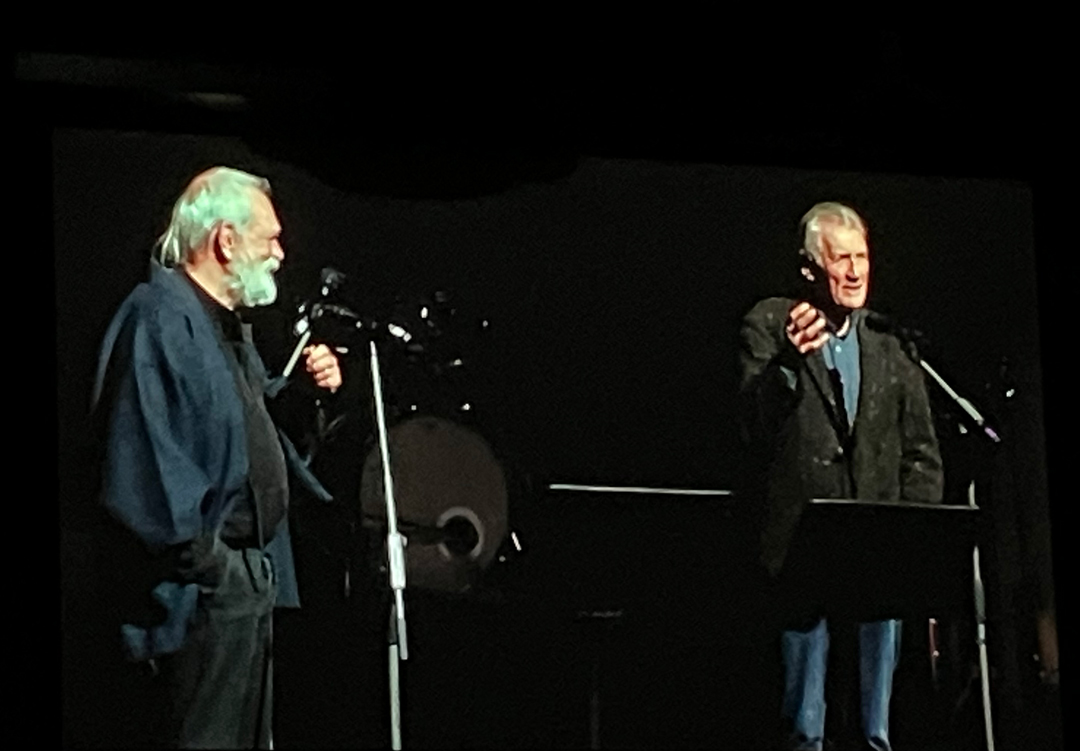
As of this writing, it’s been about half a year since the 50th anniversary of the theatrical release of Monty Python and the Holy Grail and the one-year anniversary of when I last saw Grail‘s co-director Gilliam live on-stage. He showed up, with Michael Palin, to reminisce about the recently deceased Neil Innes for a tribute concert. Palin and Gilliam shared some memories of his contributions to the soundtrack, and then led the audience in a sing-a-long to “Brave Sir Robin”. Palin fulfilled his standard role as “the Nice One”, warming the audience with his traditional, and highly valued, public-facing energy, while Gilliam came across as a bid befuddled. It wasn’t full-on worrisome, but after the deaths of both Jones and Innes, and in the middle of an event where the vast majority of the participants were men approaching full dottering-ness, it did give me pause. During the pre-recorded intro to the 50th anniversary screenings of Holy Grail, Gilliam was in better focused, jolly form, trotting out some vintage anecdotes in fine fettle.
Holy Grail has become a perennial comedy, as much beloved for being beloved, as it is funny. The 50th screening I went to was pretty well attended compared to the shocking emptiness I encounter in most other showings at that cinema. The twenty-eight other people there seemed to be comprised of people who thought they knew the script by heart; people who had fond memories of having seen it back in the day, but didn’t have a home video library; and a few people who wanted to give their kids/girlfriends the Big Screen Experience of a videotape classic. It went over well, but it didn’t have the uproarious lunatic edge I remembered vividly from my first viewing. One guy still lost it at the “A Møøse once bit my sister…” bit, and in general I would say Holy Grail‘s titles do an absolutely superlative job of sweetening an audience for the film to come. It’s an ecstatic combination of subverted expectations and excellently curated stock library music.
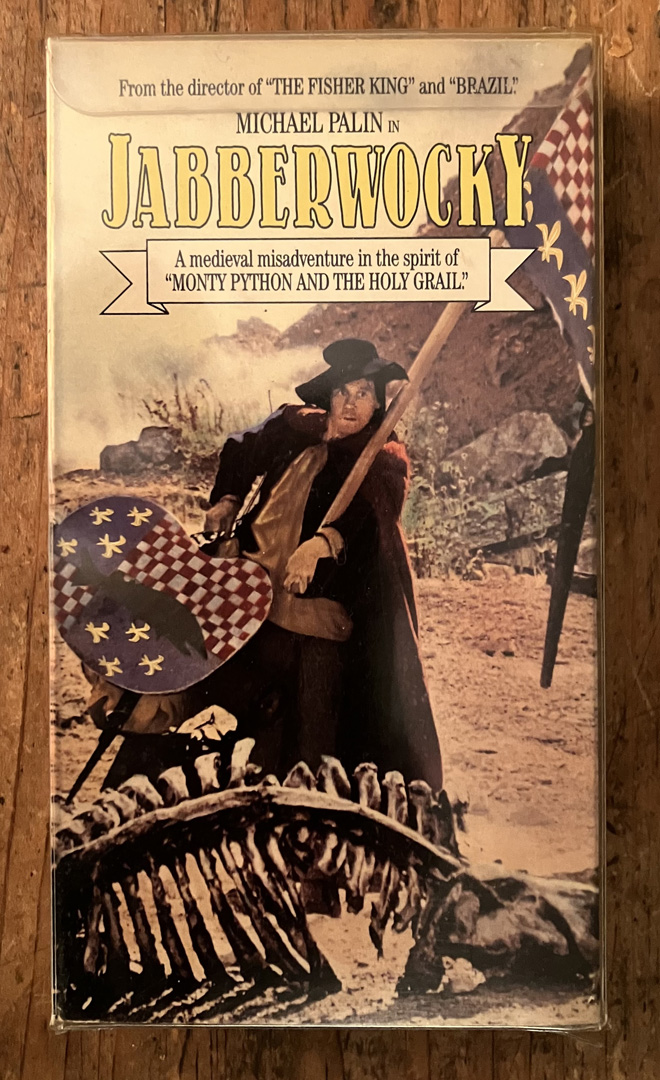
Which brings us to Jabberwocky. A difficult row to hoe, adapting one of the most-memorized poems (due in part, certainly, to its adapted use in roughly a bazillion high school chorus concerts). It certainly has the skimmings of a plot, but it’s pretty bare bones. But it is very clearly the follow-up from a director of half of Holy Grail, and it’s mere months away (does about sixteen months count as “mere”?) from having its own fifty-year re-evaluation.
Monkey 1 — Primary Primate: I can’t place exactly when I first saw this film, but I remember finding it crude and not as funny as I would have liked. Parts of it felt like as if Gilliam had taken the set-dressing and world-building from the establishing shots of Grail‘s “I’m Not Dead Yet” sketch and given them feature length. I remember liking the jabberwock itself and finding it to be an excellent adaptation of the Tenniel drawing but with the more lumpy, bulbous aesthetic of the halo of muslin and organics that encircled the Red Knight in The Fisher King, which means I must not have tracked this down on videocassette until some time in 1992 or later.
Monkey 2 — Infinite Typewriters: In Gilliam on Gilliam, Gilliam talks about the slightly accidental way in which Jabberwocky fell together out of wanting to work with Richard Lester and nogotiating other projects with certain producers. In Gilliamesque, he basically repeats what he told interviewer [name here], but with a few more conversational flourishes. The anecdotes about how small and collaborative the production was, and how much was achieved through throwing black cloth over sections of castle or repurposed sets from other films also are pretty much verbatim between the two accounts, which makes me assume Gilliam probably retells the same remembrances on the DVD commentary.
Read the rest of this entry »SIX MONKEYS: An Introduction.
I grew up with only a couple friends who had VCRs. So the opportunity to watch a movie you liked whenever you wanted to was starting to happen while I was in elementary school, but was still rare. When I was in middle school, Tim Burton’s Batman came out, and — like most movies at the time — when it was released on video it was priced at just under $90. In my opinion, Batman was one of the films that helped transform expectations of how much a video should cost: it was constantly on sale for around $25, every time with a caveat that this was the lowest price evs! and it would quickly rocket back up to full retail price, so buy it now; no, really, NOW. (This doesn’t quite mesh with searching online copies of Sears Wishbooks, which list most videos as going for about $20, but that might be because of holiday season sales or they’re no longer first-release? Memory and truth don’t always match up…) I do think it jump-started both the trend of consumers paying better attention to release-week deals in advertizing fliers, but also helped create an general unwillingness to pay more than a quarter-hundo for a videocassette. Which then became a floor that dropped even more.
But (I maintain for the purposes of this post) for some time, it was financially difficult to have a large home-video collection, and so people only tended to have splashed out for something that was incredibly precious. So when childhood friend Geoff had a copy of Time Bandits, even though I hadn’t heard of it before, I knew it was something special. We subsequently watched it together, in whole or in pieces, many times.
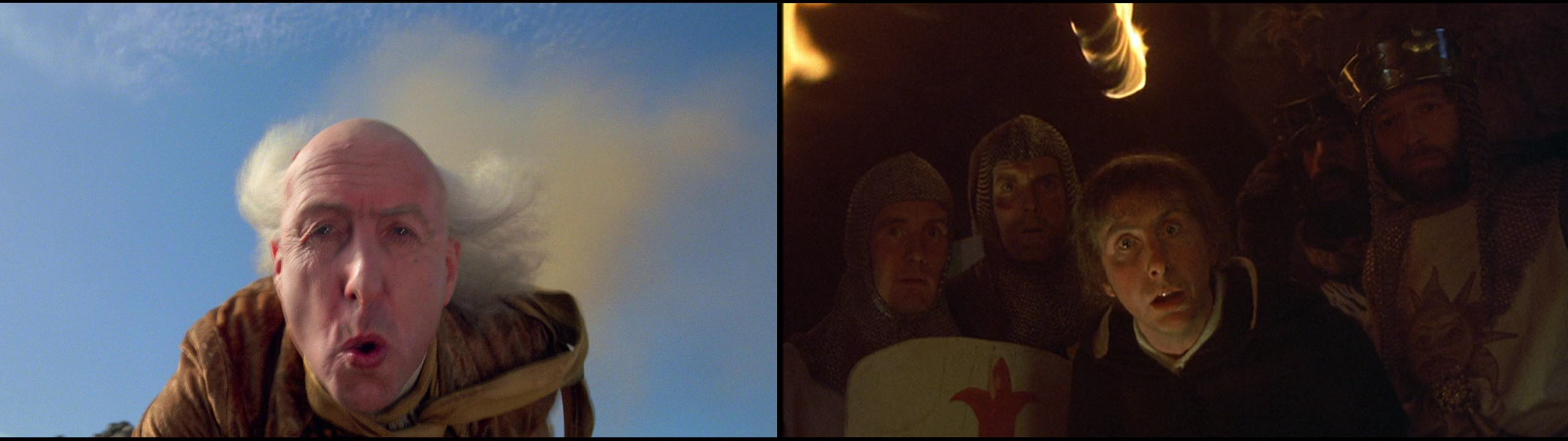
This led to watching Baron Munchausen when it came out, which then — and this might surprise some long-time listeners — led to Monty Python and the Holy Grail. I still have a distinct memory of a curved close-up shot of Eric Idle as Brother Maynard reading the carved Aramaic final testament on the walls of the cave lair of the Black Beast of Arrrrgh and realizing, “Oh, hey, that’s the fast guy with the weighted leg irons!” After a couple hours of watching closely and laughing uproariously, I only recognized him because Gilliam (perhaps?) filmed him in the same tight shot also used later during Munchausen‘s fantastical running sequences.
Gilliam as filmmaker became one of my early pretentious fandoms, and 12 Monkeys was the first of his films I was able to see theatrically screened. So, as we approach the thirtieth anniversary of its release, I thought I’d revisit it and the films leading up to it, and see how these particular half-dozen monkeys stand up to scrutiny. Gilliam has taken some stick in recent years for falling on the wrong side of the divide of Members Of Monty Python Who Know How Not To Offend The Youth On Social Media. Cleese remains the once and future offensiveness king of the four surviving members, but jolly, cheeky Gilliam has not been able to successfully convey his jolly, cheeky vibe very well in micro-blogged soundbites and snapshots. So he has been… not cancelled, but summarily dismissed as Old And Out-of-Touch. I myself am too old to be able to see clearly whether his old work would resonate with The Youth, but I remain interested in giving it a chance to stand or fall under the withering, Anubis-like gaze of critical re-evaluation. It only seems appropriate to see whether a time travel movie about saving the planet after a pandemic might continue to actually work in the future. So, here we go:
Blogalongagilliam 2025:
Dec. 1: Jabberwocky (1977)
Dec. 8: Time Bandits (1981)
Dec. 15: Brazil (1985)
Dec. 22: The Adventures of Baron Munchausen (1988)
Dec. 29: The Fisher King (1991)
Jan. 5: 12 Monkeys (1995)
Jan. 12: BONUS! 12 Monkeys Season 1 (2015)
I Like Charade in June/ How About You?
As is inevitable in this day and age, one occasionally gets involved in a “What was your lockdown like?” conversation. I just avoided going to a college reunion, and I’m sure much of the smallest of talk would have centered around trading anecdotes about isolation from family and support structures, about juggling parenting, schooling, and work-from-home, of eldest children trying to figure out how much college was actually worth when another Covid variant could cause another stretch of remote learning from within the college’s dorms. The personal cost of the pandemic has been and will continue to be wildly varied, which makes it both an interesting conversation starter and an easy way to reveal vast gulfs of experience on either side of an anecdote.
My final pre-shutdown experience back in March of 2020 was deciding that it probably was not the better part of valor to venture out to a Welcome to Night Vale performance when I knew the governor was about to declare a state of emergency as soon as the timing was right for a press conference. But a scant two weeks before that, I’d closed out a weekend of entertainment by walking around the Museum of Modern Art with an old roommate talking about the growing fears of infection and how seriously we should take the burgeoning news coverage. Prior to that, the weekend had consisted of my first ever attendance at an actual Broadway show and the achievement of a long-awaited dream of visiting the New York Public Library’s Charade collection.
That’s not what it’s officially called, of course. But, as I’ve previously mentioned, the Library of Performing Arts’ collection of the papers of Charade screenwriter Peter Stone were an enticement that had been hovering over my NYC visits for some time. I’d previously had an opportunity to swing by and plunge into the archives, Scrooge McDuck-stylee, in November of 2017 when I unexpectedly found myself with five hours to kill between planned events. But I was with company and asking them to wait while I poured over ephemera of little interest to anyone else felt like the height of rudeness (he says on a blog where he’s detailing some of that ephemera). So I put it off until I found myself with another window of time to kill between events and was flying solo. Some people find it lonely and a little scary to travel by one’s self, but I find if one is looking to spend a literal half-day taking notes on contract details and script annotations of a minor ’60s romantic thriller comedy, it’s best not to trespass on another person’s patience. My friends were politely bored enough having to listen to me gush about the experience afterward; to deal with with it in real-time would surely have been unreasonable.

What is reasonable, unfortunately, are the fairly stringent copyright protections instituted by NYPL about the fabulous things that I found there. Obviously, they are aware that they have many, many things in their collection that are not in the public domain, and despite the fact that anyone with a digital camera and a library card could cheerfully make the protected contents of their archives significantly less protected, their policy states that “The Library does not grant written permission for any type of use of reproductions taken by readers“, and that photographs are only for “personal use”. I have read and re-read the permissions policy, and while I would say that the narcissistic ouroboros of non-commercial blogging is much more adjacent to personal use than it is to publication, I understand that this perspective probably wouldn’t stand up against a cease-and-desist notice. Since copyright is designed to prevent unlicensed reproductions that will stifle, divert, and lessen sales, excerpts or “transformative works” that aren’t going to reduce access to and sales of the original aren’t considered violations. Which is why this post won’t be a catalogue of all the minutiae I’ve teased above. I have instead clipped a portion of an image from the NYPL’s “Peter Stone” image collection of a man in a smart… waistcoat, but changed it enough to hopefully make it something sufficiently Other. I’m pretty sure that is permissible — and desirable, as something to slightly break up this unremitting block of self-indulgent twaddle with an image — but I’ve been wrong about the legality of Charade-based copyright issues before.
Read the rest of this entry »Unsinkable! She Alive, Dammit! (It’s a Miracle!)
As of yesterday, it’s been 25 years since the countrywide opening of James Cameron’s Titanic, and it’s been seven months and three days since I finally watched it for the first time. We all have films that we’ve foresworn against, not because of having actually watched them, but because of the way they were sold to us. I remember my stepbrother going from hot to cold on Batman in 1989 as the hype amassed. As more and more people told him how great it had to be based on the budgets and the promotional photos and merchandizing, the more his fundamental contrarianism marshaled arguments based on similar — if not the same! — snapshotted details. As a young person who’d been swept away the achievements of Terminator 2: Judgement Day, who’d been wowed by the relentless pulp of True Lies, and who — having read and re-read Orson Scott Card’s expansion of The Abyss — hoped that one day the eventual video release of the extended director’s cut of Cameron’s full-budget vision would salvage the deus ex profunda ending, I should have been in the proverbial fifteen million-gallon tank for Cameron’s disaster romance. But I wasn’t. I found the whole existence of the exercise crass, and all the details that emerged about the manic attention to accuracy and the whirlwind glamour of the central story served only to bolster my recalcitrant position. I was the Titanic “truther” of 1997.
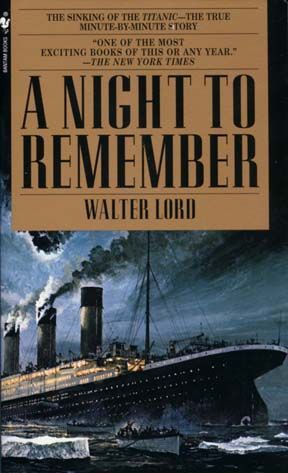
And why was this? At its heart, it was because in elementary school I’d read and re-read the Walter Lord’s step-by-step retelling of the sinking, A Night to Remember (a title I always think of when high school proms inevitably use that as the motto for their coming-of-age event). That slim volume — which only breaks two hundred pages by including the passenger list at the end — captured my imagination in a way that few other non-fiction books did. Despite being, notionally, a boy, I don’t have any memory of going through the traditional concrete operational period of falling in love with mechanics and statistics. While many, manymany boys process a desire for and attraction to functional and measurable aspects of reality, becoming obsessed with fire trucks or train sets, or starting to memorize baseball statistics, the closest I got to this sort of world was loving Lego and instinctively memorizing all the members of the X-Men. But, for me, that was about storytelling and characters, and the Dorling-Kindersley approach to the world — pictorial categorization of concrete phenomena — wasn’t interesting unless there was something especially aesthetic or connected to media where I’d become invested in the ‘verse.
So A Night to Remember was an interesting combination of those two worlds — a minute-by-minute accounting of events, decisions, and individuals involved in the collision, evacuation, and sinking, but told in a way that I could envision it as a narrative — but also with enough tension between the two techniques that I returned to it again and again… potentially looking for color, personality, and something beyond the blank, absurdist tragedy of the event to hang my hat on. And, weirdly, I did read and re-read — sometimes dutifully, sometimes skimming — that list of names, looking for something or someone to connect to that would make it real in a personal sense instead of in the larger, abstract sense of Having Actually Happened.
From that perspective, Titanic, as James Cameron executed it, should have been exactly what I wanted: the ability to distill it down to an emotional adventure story so that it existed both on the micro and macro scopes, historical and personal, massive and individual. But it didn’t strike me that way. Somewhere between ages ten and twenty-one, I’d embraced an adolescent ’90s nihilism that made me content with the stark, appalling meaninglessness of the true events. I suspect that this happened after the National Geographic footage of the rediscovery of the ship in its resting place, majestic in size, but otherwise smeared by decades of the uncaring sludge of Nature. Much like having hubristically declared the ship as “unsinkable”, any glory or status it might have had was now diminished beneath the weight of organic inevitability, making Titanic look like a the flagship in a cruise line designed by Antoni Gaudi.
So the decision to make a spectacle of the glory of the boat, of recreating it as exactly as possible, and lavishing Titanic‘s extraordinary budget on facsimiles to be deliberately destroyed felt weirdly tone-deaf to me. If there was anything the underwater cameras showed us, it was that glitz and glory will crumble to the inevitability of rot and ruin. So to spend so, so much money to recreate the folly, and to spend so, so much money recording its deliberate destruction felt asininely wasteful. And to do it in service of a romance between two fictional people, created deliberately to represent the simplistic Harlequin Romance transgression of attraction across classes (!!!) felt disrespectful to the people who’d actually suffered and died, and whose names I’d read over and over.
Read the rest of this entry »Gather in the Drawing Room
My current practice of saving certain articles until I have time to concentrate on them has meant that I found out about the Fake Teenagers Festivus Blogathon a couple days late. Looking at my collection of oft-revisited physical media, I’m not sure what I would have immediately leapt to cover — perhaps Edward Scissorhands, which featured a 20 year-old Winona Ryder and a 22 year-old Anthony Michael Hall — but my secret goal of becoming relevant as a figure on Film Twitter will certainly be harder to achieve if I’m not pursuing clout and chasing trends before Twitter inevitably wheezes its final death rattle. Which means I will need to read movie commentary and articles, not at some distant leisure and certainly not after waiting a week for new cinema releases to lose lustre so I can see the film with a minimal audience on a Tuesday night. No, I might need to cultivate the anxious, wide-eyed panic of someone consumed with worry about no longer being streets ahead.
The recent film I did get a bit of a jump on was Glass Onion, which ended its limited theatrical release yesterday night before pausing to return as a cozy staple on Netflix in a month’s time. It was important to me to see Glass Onion in cinemas, as I have seen all of Rian Johnson’s film output in theatrical release so far, and I didn’t want to break the streak.
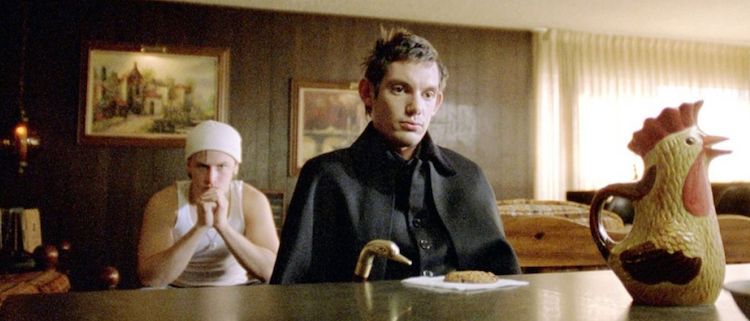
I believe I heard about Brick back when I was haunting the corridors of the TwitchFilm website (which I probably discovered chasing breadcrumbs about the theatrical release of Serenity, for my sins). I drove from grad school in Western Mass to the Coolidge in Boston to see a screening of Brick, and while I was disappointed with the fidelity of the digital projection, I was at least glad to have seen it in as large format as possible. The essential flashy conceits — the noir trappings, the arcane Young Person Code, and the curious mechanism where the plot of the film is being acted out by the high school theatre company while it’s still happening to the protagonists — were all attractive and clever, but I really responded to its essential technical filmmaking: the photography and the sound mix. I found myself won over by the choices of putting the strong, distinctive images together with the borderline absurdist touches that occurred throughout the script and production (Lukas Haas’ character’s accumulated quirks — the floor lamp in the back of his van, his mom’s chicken-shaped juice jug, and his attempt at making a human connection with JGL over the Tolkien books — all had me convulsing with laughter). It felt like a visual voice I wanted to continue to know, and it got me to follow Johnson’s career ever since.
IMDBLR: Son of IMDBLR
November 2015 was my fifth anniversary of my first joining and participating in the Kickstarter community. Slightly less than a year later, I backed my one hundredth project. In that time, I’d spent approximately $1,200 each year on autographs and comic books and albums and wedding presents and lithographs and fundraisers and film productions. I’d read articles decrying the fact that Kickstarter took advantage of funders because it wasn’t an investment system. If I’d been a producer on those films and albums and comics, and they’d proved to be successful, then I would have enjoyed a return on my investment. Instead, I would receive a shipment of tat, critics scoffed, and someone else would reap the real benefits.
I’m sure that somewhere in those 17 projects each year that I backed, one or two of them would be considered “successful”, but for me, the main draw of Kickstarter has always been the projected sense of “participation” in a given creative project. The updates from the creators are key to this: a regular series of follow-up messages about the progress and process of the actual project do make me feel like I’m involved, even if all I did was be part of the crowd of funders. It’s the — perhaps illusory — feeling of participation and pride that is the best part. And so the ability to point at one’s name and say, “I made this happen!” has become the real reason I continued with Kickstarter so avidly for so long.
Shortly after the end of the projects listed here, I backed off of Kickstarter. Not because of the money — although that clearly should have been a consideration, now that I crunch the numbers — but because I did come to the understanding that my internal sense of my “involvement” in these things was overinflated, and that they were part of a larger project of retail therapy I’d been participating in for some years. I enjoyed the vicarious thrill of the projects and the stories I was able to absorb from the production updates, but what I was really doing to a large degree was spending money to have exciting mail show up at some unexpected future date — and with Kickstarter projects, that date was almost always in significant flux… I needed less stuff in my life, and I needed less momentary novelty and excitement provided via the acquisition of said stuff.
There are still eleven outstanding film projects that I have backed — only four additional since I hit a hundred backed projects four years ago — and only three of which I believe will list my name in any manner (not including the Kurt Vonnegut documentary that already has me listed on their website). While I’m no longer actively chasing this kind of validation, I might as well keep cataloguing the last five projects that do name me and the last five that didn’t…
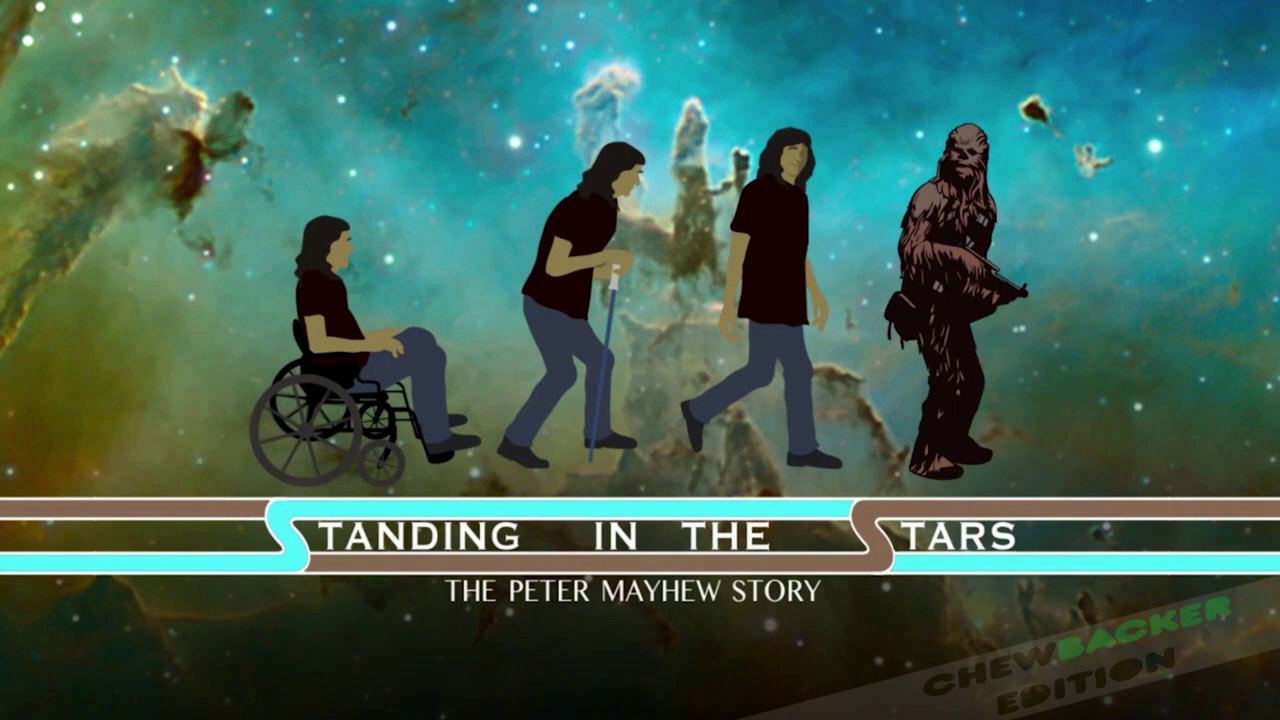
STANDING IN THE STARS: THE PETER MAYHEW STORY (Raised its minimum funds on Sept. 14, 2013, still unreleased)
THE FELT-LINED COUNTDOWN: The Muppet Movie
PREVIOUSLY: It’s all been building to this: the beginning of it all, if you don’t count, y’know, the TV show and the talk show appearances and the general omnipresence. This was huge. And it was. Box Office Mojo doesn’t have the opening weekend numbers for The Muppet Movie, but it does list the overall gross at $65.2 million in 1979 money, which adjusts to $234 million today, kicking the revival success of The Muppets at a comparatively mere $101.8 million into a cocked hat. It was wildly successful financially, and continues to be a massive emotional touchstone for fans and families.
And what’s weird is that it doesn’t even start with the banjo. It feels like it should. The DVD does. The Blu-ray does. The Blu-Ray’s “Intermission” feature does. It’s hard to imagine that this iconic picking wasn’t something that pre-grabs an audience and transports them back to memories of this film, but was once an eight-bar intro to an unknown quantity. And its even weirder that the film takes forever to get there, with a truly extended bookend sequence, that’s incredibly slowly paced and does little that’s iconic, with two exceptions: Kermit’s dialogue to Robin (“It’s sort of approximately how it happened…” and the fact that the theatre screening seats that were designed to hide Muppeteers beneath them have now become the standard for cinemas.
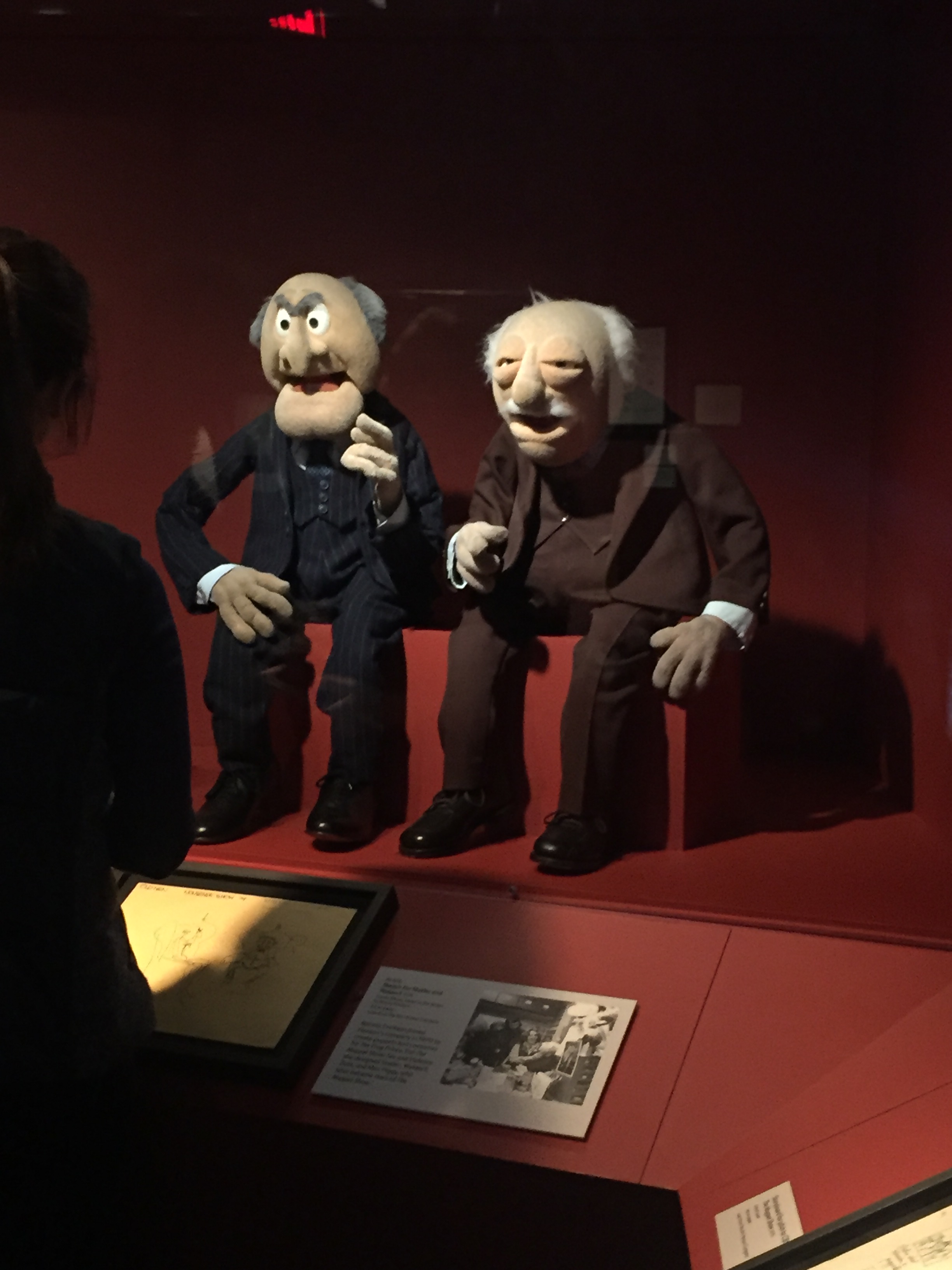 However, it would be remiss of me not to point out that The Muppet Movie does open with an absolute goddamn public service: it not only names Staler and Waldorf — names I can’t remember not knowing, but which seem to be largely opaque to much of the general public… a comprehensive text search of transcripts of current podcasts as well as conversations around me at the Museum of the Moving Image’s Jim Henson exhibit would reveal that hardly anyone knows that “those two old Muppets in the balcony” even have names — but also tells us which is which, something even I have trouble remembering on occasion. The film then very leisurely introduces the various personnages with a series of small in-character moments. The whole thing is very unhurried, maybe even deleteriously so. So it’s a welcome gag that Animal and the various Muppets (while displaying the worst cinema-going etiquette ever… something that they apparently were wont to continue thirty-two years later) get impatient for the film to begin and bully Kermit into starting the film without thanking everyone involved. (A joke, of course, continued in Muppet Caper‘s credits, as well — as I’ve previously mentioned — as in Bloom County in 1982.)
So it’s a full four and a half minutes before the banjo strings do their thing and our heartstrings do ours. Read the rest of this entry »
THE FELT-LINED COUNTDOWN: The Great Muppet Caper
PREVIOUSLY: As Fran Kubelik tells us, “Some people take, some get took — and they know they’re getting took — and there’s nothing they can do about it.” Well, Manhattan done got taken, that fool of a Took.

While Manhattan is my brother’s favorite Muppet film, and while I think some of his comments and perspective helped me appreciate it as a sketch-movie, my comments about its utter lack of an earned ending do stand. And after finishing watching and reading about Muppets Take Manhattan, I was looking forward to revisiting my personal favorite of the Muppet franchise, and seeing how well it holds up and how well it might weather the scrutiny I’d been applying to the other Muppet offerings.
The disappointing news is: not well. I’ve been doing a whole bit over the course of this series where I’ve found a Group of Three, highlighting it early in the write-up, and eventually using it as the way of rating the film as a Success, a Mixed Bag, or a Basic Failure. The obvious way to do that with Caper is with Fozzie, Kermit, and Gonzo’s shipping containers. My notes say that my alternate take for ratings of this movie were going to be “A) Credit Card, B) Cash, or C) Sneak Out In The Middle Of The Night.”


Which would mean, if this film was only middling in its success, I’d have to give it a RATING between Bears, Frogs, and Gonzos of Frogs, which seems mildly insulting to Kermit. Surely a rating of Frogs should be excellent! Something that’s a mixed bag should be a rating of what is says on Gonzo’s crate, which is Whatever, but that’s the lowest rating, which this film doesn’t deserve. Or, at least, my twenty-year upholding of this film as the pinnacle of Muppet filmmaking won’t let me allow it.
Because, unfortunately, what I love about this film is the strange tone and pacing and the excellent post-modern wall-breaking, and almost all of that goes out the window in the final act, leaving us with a badly-paced, badly-assembled mess that needs more than charm to let the audience feel like their earlier generosity was justified. The deconstruction and chaos need to either pay off in a manner that shows that the clash of fiction and metafiction was purposeful, or need to build to a complete explosion of structure that just abandons structure altogether.
But, in order to show how it goes wrong, we do have to start at the start. Which is pretty wonderful.

THE FELT-LINED COUNTDOWN: The Muppets Take Manhattan
PREVIOUSLY: The Muppets Take Victorian London. Those Muppets. It’s always take, take, take…
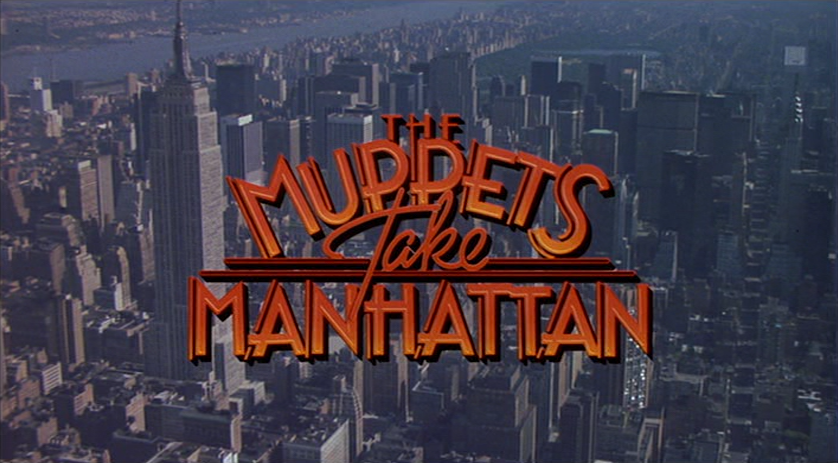
The film opens with a helicopter shot of New York City, and if you couldn’t already recognize parts of the skyline as dated, then the lack of a gyroscopic stabilizer on the camera would thorough date this footage as from the ’70s or ’80s. Immediately, the music starts with a loose series of dooting by Kermit, kind of scat singing — harkening forward to Whitmire’s excellent caroling with Tiny Robin in 1992 — but not really deviating from the melody as much as I associate with true jazz scat. Regardless, it is a pleasant introduction to the melody of “Together Again”, the song so catchy that they used it again as the closing number to Most Wanted thirty years later.
During this charming ditty, the name of the composer to the song comes up, and I have no idea who this is. “Music and Lyrics by Jeff Moss”? Who is this workaday imposter, I pre-emptively bristle. Well, allow Wikipedia to allay my immediate suspicions, as it turns out that Mr. Moss is the writer of “Rubber Duckie” and “I Love Trash”. This explains the catchiness of both the opening number and the later appearance of “I’m Gonna Always Love You”. I probably should have been able to let the music speak for itself, but it does help to know that the compositions come from the Muppet stable, as it were. It gives some faith in the proceedings to come.
That faith, unfortunately, is largely squandered in my eyes. The film has a perfectly fine notional story, with the Muppets taking their senior college revue to New York to try and get it produced on Broadway. Perfectly ordinary Rise To Fame narrative that would be pleasant… if it wasn’t basically the plot of The Muppet Movie from five years before. But that!, I hear the movie implore, was a film about a ragtag group of strangers coming together and finding each other; their success is based on the fact that they were stronger with each other! So the stakes of this movie will be that initial failure forces them to separate, and we are anxious about getting them reunited. All of this is encapsulated by the opening, which is the finalé of Kermit’s revue! So the film starts with its eventual conclusion, and it will all be full circle!
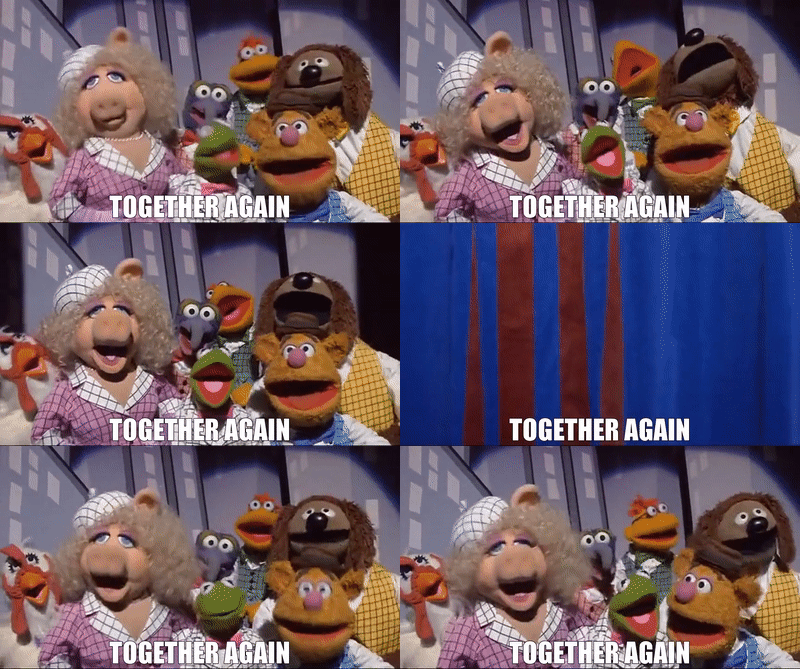
Which is a pretty great pitch. Which the film, I say again, squanders in many ways. I realize that I’m jumping straight to the end of the film, but the ending is very much what makes me stamp out of the cinema — or, now, my living room — irritated at the logical inconsistencies in the construction of this film. A film is not its ending, but the ending is the last thing a film leaves you with, and it can absolutely sour the previous hour and a half. The fact that the film doesn’t end with “Together Again” is nuts. Everything about the musical that they stage is nuts. It defies belief, it leaves me frustrated and irritated, and it makes me want to buy Muppets Take Manhattan Burger King glasses on eBay just so that I can smash them.
So let’s establish how the film violates our faith. Read the rest of this entry »
 RSS feed
 smartovercoat.com