SIX MONKEYS: Time Bandits (1981)
Previously: After Michael Palin’s father dies in a Caravaggio painting, he goes to the city and stumbles into the midst of several adventures and a poem. If Gilliam hadn’t already co-directed Holy Grail, this might have killed his career while establishing it…
For some reason, I always think that Brazil is Terry Gilliam’s second movie. I’m not sure why. But in my head he has the same narrative as Christopher Nolan: the first film is slight and underseen, basically an amateurish calling card, and then the second one has all the hallmarks that will underscore his auteur status for the rest of his career. And while that remains true regardless of whether Time Bandits or Brazil is his second offering to the movie gods, somehow it’s more impressive if it’s Brazil.
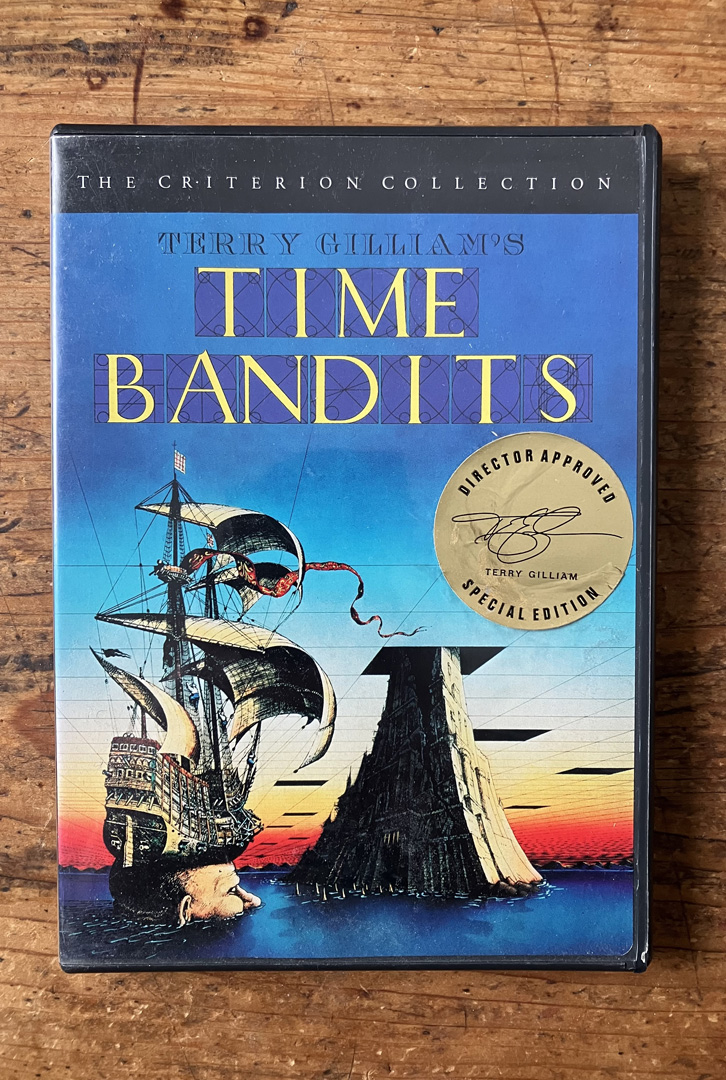
That said, I prefer Time Bandits. Is this in part because I saw it, in whole and in pieces, so many times as a child? Oh, almost certainly. There’s some powerful nostalgia baked into this film in three different ways. Actually, let’s just get into it:
Monkey 1 — Primary Primate: Because, as established in the introductory Six Monkeys post, I watched this so many times over at Geoff’s house, I don’t have a clear memory of watching it for the first time. What I have is a sense of how this movie fits in with other films of the time. In re-watching it, I can see details in the set-dressing of Kevin’s bedroom that helped make it feel real and helped establish the Proustian sensory detail that telescopes me back, Ratatouille-style, to the memories of my own childhood. Kevin’s dun-colored scratchy fake-wool blanket with the shiny polyester trim is absolutely a blanket that existed in my own bedroom, and is what I would swaddle my face in when I had the unaccountable sense that something was moving in the closet in the dark. Did I catch that particular detail when I was watching it in the ’80s? Absolutely not, because it’s almost impossible, as MacLuhan talks about, to see the context of the environment you’re in, and those blankets and those kid fears were too omnipresent to have been seen as a decision and not a default.
Monkey 2 — Infinite Typrewriters: Michael Palin’s diary volume Halfway to Hollywood opens with the extended process of Time Bandits with the first draft being written in a series of scene and story conferences between Palin and Gilliam over the course of January 1980 as a challenge to allow Palin to then concentrate on other work, but the refinement of the script then continues to interrupt his other plans and prevent Gilliam from attending general Python meetings in which the groundwork for what will become Meaning of Life. Palin films with Shelley Duvall in June, is still tweaking dialogue in September for looping, sees an assembly cut in October — “It really is the most exciting piece of filming I have seen in ages” (p.57) — and is editing the script for publication as a tie-in book in December when he hears the news of John Lennon’s death. Time Bandits: the movie script is not by the same publisher as the Holy Grail or Life of Brian script books (they are by Eyre Methuen, whereas this newer offering is from Doubleday Dolphin), but it has a similar vibe, with set photos and Gilliam storyboards collages in amongst the script pages, and a couple section of lavish color plates. While Palin has mentioned “the future scene” his his diaries multiple times (hence the rocketship Wally shows up in), including mentioning the day on which they decided to cut it, it does not appear here as a dangling thread. Maisie and Myrtle, though, cut from the film, are included in their strange The Furies-cum-Circe way, as are photos of their removed scene. Joan Hickson is credited as Myrtle in the final cast list in the book, but whoever played Maisie seems to be lost. The spider-women, as they’re sometimes referred to by Palin and Gilliam, do not appear in the children’s novelization of the film by Charles Alverson, but then again, neither does any of the superlative, hilarious dialogue between Vincent and Pansy about Vincent’s “problem” that has kept them apart, yea these twelve years.
Read the rest of this entry »SIX MONKEYS: Jabberwocky (1977)
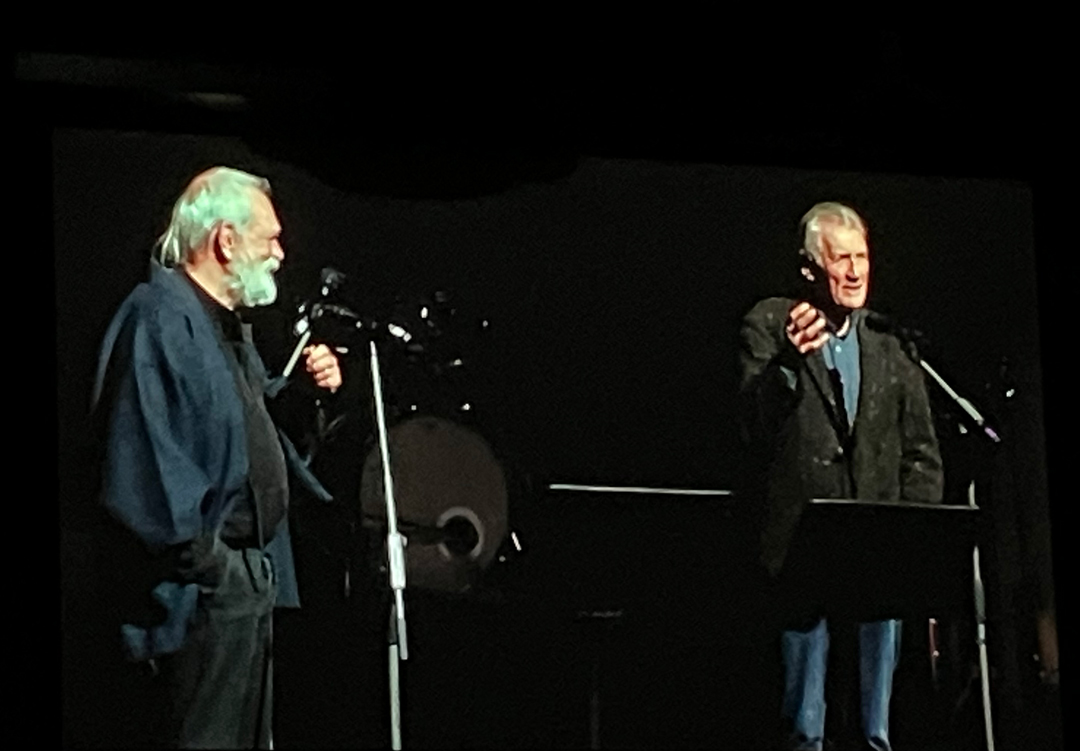
As of this writing, it’s been about half a year since the 50th anniversary of the theatrical release of Monty Python and the Holy Grail and the one-year anniversary of when I last saw Grail‘s co-director Gilliam live on-stage. He showed up, with Michael Palin, to reminisce about the recently deceased Neil Innes for a tribute concert. Palin and Gilliam shared some memories of his contributions to the soundtrack, and then led the audience in a sing-a-long to “Brave Sir Robin”. Palin fulfilled his standard role as “the Nice One”, warming the audience with his traditional, and highly valued, public-facing energy, while Gilliam came across as a bid befuddled. It wasn’t full-on worrisome, but after the deaths of both Jones and Innes, and in the middle of an event where the vast majority of the participants were men approaching full dottering-ness, it did give me pause. During the pre-recorded intro to the 50th anniversary screenings of Holy Grail, Gilliam was in better focused, jolly form, trotting out some vintage anecdotes in fine fettle.
Holy Grail has become a perennial comedy, as much beloved for being beloved, as it is funny. The 50th screening I went to was pretty well attended compared to the shocking emptiness I encounter in most other showings at that cinema. The twenty-eight other people there seemed to be comprised of people who thought they knew the script by heart; people who had fond memories of having seen it back in the day, but didn’t have a home video library; and a few people who wanted to give their kids/girlfriends the Big Screen Experience of a videotape classic. It went over well, but it didn’t have the uproarious lunatic edge I remembered vividly from my first viewing. One guy still lost it at the “A Møøse once bit my sister…” bit, and in general I would say Holy Grail‘s titles do an absolutely superlative job of sweetening an audience for the film to come. It’s an ecstatic combination of subverted expectations and excellently curated stock library music.
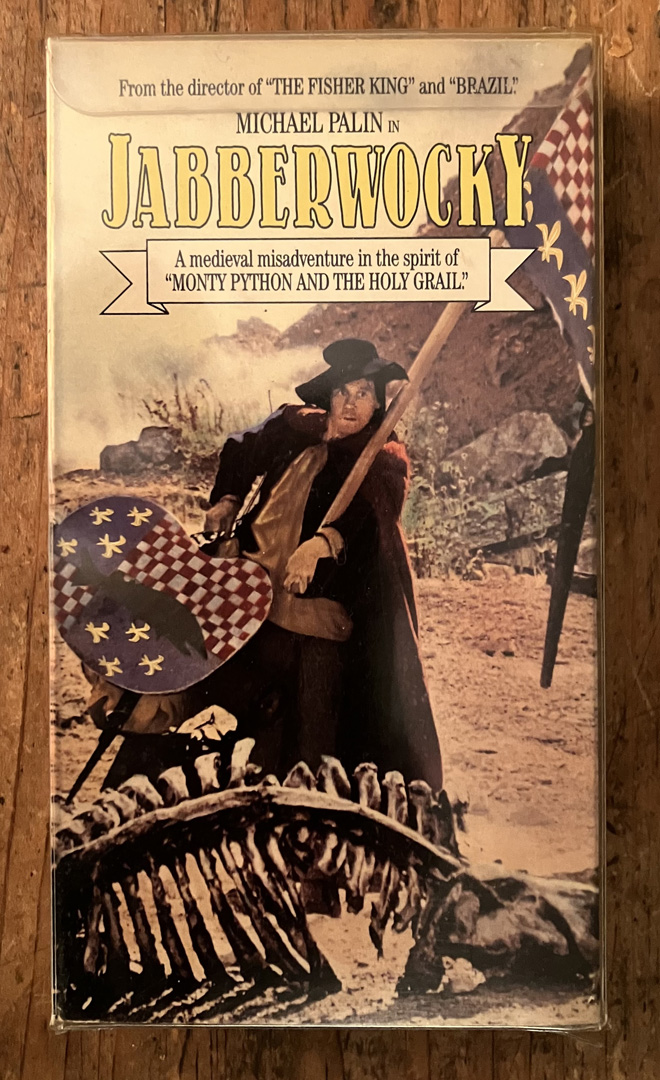
Which brings us to Jabberwocky. A difficult row to hoe, adapting one of the most-memorized poems (due in part, certainly, to its adapted use in roughly a bazillion high school chorus concerts). It certainly has the skimmings of a plot, but it’s pretty bare bones. But it is very clearly the follow-up from a director of half of Holy Grail, and it’s mere months away (does about sixteen months count as “mere”?) from having its own fifty-year re-evaluation.
Monkey 1 — Primary Primate: I can’t place exactly when I first saw this film, but I remember finding it crude and not as funny as I would have liked. Parts of it felt like as if Gilliam had taken the set-dressing and world-building from the establishing shots of Grail‘s “I’m Not Dead Yet” sketch and given them feature length. I remember liking the jabberwock itself and finding it to be an excellent adaptation of the Tenniel drawing but with the more lumpy, bulbous aesthetic of the halo of muslin and organics that encircled the Red Knight in The Fisher King, which means I must not have tracked this down on videocassette until some time in 1992 or later.
Monkey 2 — Infinite Typewriters: In Gilliam on Gilliam, Gilliam talks about the slightly accidental way in which Jabberwocky fell together out of wanting to work with Richard Lester and nogotiating other projects with certain producers. In Gilliamesque, he basically repeats what he told interviewer [name here], but with a few more conversational flourishes. The anecdotes about how small and collaborative the production was, and how much was achieved through throwing black cloth over sections of castle or repurposed sets from other films also are pretty much verbatim between the two accounts, which makes me assume Gilliam probably retells the same remembrances on the DVD commentary.
Read the rest of this entry »
 RSS feed
 smartovercoat.com