THE FELT-LINED COUNTDOWN: Muppet Treasure Island
PREVIOUSLY: Gonzo can never refer to himself as a “Whatever” ever again. Except I don’t think we ever learned what his people are called… And I remain disappointed that there wasn’t an explicit reference to Koozebane anywhere in the film.

The film opens with a long slow pan over physical mountains on location and seamlessly wipes to a studio lot that allows a mixture of Muppets and men to interact in song-styled backstory as narrated by Billy Connolly. There’s quite a bit going on here, according to director Brian Henson on the commentary track. He mentioned that this complicated melding of a composite helicopter pan with an on-set dolly pan was the same technique he used to open Muppet Christmas Carol, thus allowing us to infer that he feels it should be either a signature move for him as director or for Muppet movies under his watch. What’s interesting is that Henson is successful enough at the technical melding of the elements that it looks smooth and therefore feels… underwhelming? It should feel spectacular, but instead it just feels like a jumble.
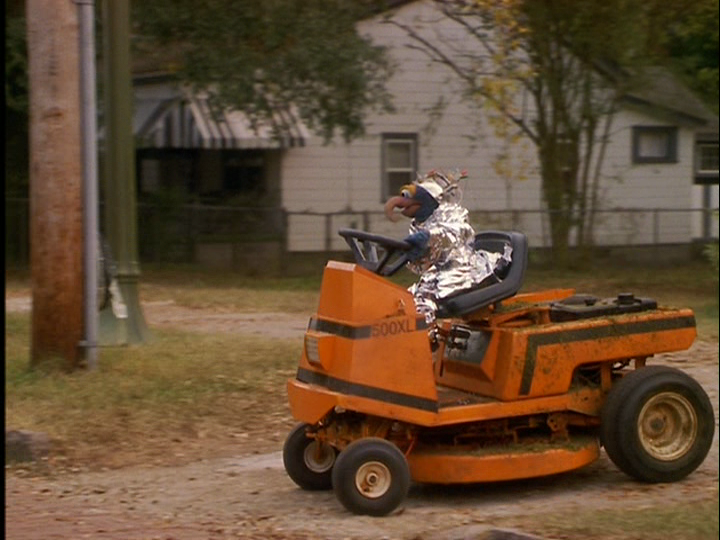
While well done, it’s not showy enough to be impressive, which is a metaphor for the entire movie and perhaps the existence of the Muppets at large. We’ll return to the bicycles alluded to in this series’ intro post to see how full-body Muppets in space — like Gonzo on his tractor in Muppets in Space — are a technical achievement that becomes sufficient normal that audiences, instead of saying, “Wow, how’d they do that!”, are more likely to think, “Oof, we should not be able to see Fozzie’s legs.” Trick photography, well-constructed sets, Muppeteers stuffed into underwater tanks, and multiple stunt Muppets employed through careful cuts are all employed to take the characters from their artificial Muppet Theatre random half-height walls and place them in the Real World. And when it’s done well, it’s almost invisible. And perhaps that invisibility helps reduce the amount of craftsmanship involved.
 Degrees of invisible craftsmanship are relative, though, when it comes to fake animals and singing foam statuary. It is acceptable to have the singing statues in the opening number look like Muppet statues, rather than have them be, say, photo-realistic stone idols that magically, seamlessly have flapping mouths. The former is part and parcel of what an audience accepts when it attends something with the Muppet trademark attached. The latter hypothetical scenario would also require realistic acting on everyone’s part, and would involved far fewer flagrant demolishing of the fourth wall.
Because the nominal stars of this film — in addition to the novel’s traditional human lead, Jim Hawkins — are Gonzo and Rizzo playing their twentieth-century selves. Read the rest of this entry »
THE FELT-LINED COUNTDOWN: Muppets From Space
PREVIOUSLY: A beloved cast of pigs and frogs and dogs and bears and whatevers apparently wasn’t relatable enough, so a brand-new humanoid Muppet was created to save us all. What is this, Sesame Street?*

Well, not to make another entry focused primarily on music, but I feel obligated to begin by recanting my previous position that The Muppets was the first needle-drop Muppets soundtrack. Boy, was I wrong. The Muppets from Space soundtrack is a jukebox playlist that is as funky as it is dissonantly idiosyncratic. After the standard space-referenced star-field credit sequence, we arrive in a dream sequence where Gonzo is prevented from getting on the ark by F. Murray Abraham’s Noah. This is followed by the film’s opening number, a sequence of how long a wait it is to use the bathroom in the morning in the Muppets’ communal house. It’s a mildly amusing bit, gentle in its mundanity, but mystifyingly set to “Brick House” by the Commodores.
Personally, I have never been completely sure how, precisely, this song has been complimentary to its subject. Sure, “she’s mighty mighty, just lettin’ it all hang out“, but you’re still eliding the expression “she’s built like a brick shit-house”, which is a kind of sturdy, fecal association that one doesn’t necessarily associate with elegance, let alone with a sense of community. What is this song doing here with this scene? Did someone do a word search for songs associated with bathrooms and this was the only result that truly kicks it?
 Probably not, because the soul/funk timbre of the soundtrack continues beyond this intro. It’s a lovely, strange series of needle drops that never particularly gels with the theme or the content of the film. Despite the fact that the concept seems to have come from an initiative by director Tim Hill, I couldn’t find any connective tissue between this soundtrack and the message, lensing, or theme of the movie. The film ends with — Spoiler Alert! — Gonzo’s extraterrestrial bretheren arriving and singing a cover of “Celebration” by Kool and the Gang, but an alien funk performance does not necessarily justify an entire audio soundscape with no other connective tissue. My bemusement with the “compliment” of the lyrics aside, “Brick House” is a great song, as is the later use James Brown’s “Get Up Offa That Thing” for Gonzo’s The Straight Story-esque journey to the television station, which also doesn’t really work but fakes it admirably.
But I’m getting slightly ahead of myself. Read the rest of this entry »
THE FELT-LINED COUNTDOWN: The Muppets
PREVIOUSLY: Three years after this, the next film picks up mere seconds after this film’s conclusion, and dueling Kermits vie for control of the troupe in a trope-filled trip across Europe.
Well, it’s a small thing, but the second The Muppets begins, with the above title card floating in a hazy 4:3 aspect ratio in the middle of a wide screen, this film marks itself as separate from all other Muppet films: by unadorned use of pop music. The Muppet Show was, of course, no stranger to either use of or focus on a contemporary hit or a died-in-the-wool radio classic, let alone folk songs or ballads. But while covers and musical guests filled out the television shows, the films have always seemed to eschew anything except original music. The Muppets has its fair share of original songs, but the very first impression is one of nostalgia, deliberately evoked by Paul Simon’s ’72 release “Me and Julio Down by the Schoolyard”. For a film that’s about creating a bridge between the current generation and the previous, culminating in a demonstration that the fans of the Muppets never really went away, it’s a clear (possibly manipulative) way of evoking the past. This is undercut only by the fact that young people may not actually connect with a chipper playground tune by half of a sixties folk-duo, and not-young people, like me, may have the song already firmly and inexorably assigned in their heads to the Royal Tenenbaums montage.
About a third of the way through the film, we have a second pop needle-drop, with the accumulated Muppets rebuilding the dilapidated Muppet Studios to a montage of Starship’s “We Built This City”, a tune I still vividly associate with watching animation from Kidd Video one Saturday morning in 1985. It’s a strange choice, in that apparently it’s a song that has largely been reduced to the internet’s lazy choice for “worst song ever” (an achievement I usually still reserve for Dave Barry’s choice of “MacArthur Park”), and again therefore doesn’t seem like the likeliest of affecting bridges between the old generation and the new.
The next two homages feel more appropriate: two skits in the Muppet Telethon do a good job of capturing the kind of viral reappropriation the Muppets had excelled at in 2008 and 2009. The first is the eyebrow-raising choice of having Camilla and the chickens cover Cee Lo Green’s “Fuck You” — a very strange thing to see as the title of an entry in the Muppet Wikia pages — which is fun in that since the entire song is performed in Chicken, the existence of profanity is skated over, but still feels like an edgy choice for a Disney production. Similarly, the necessity of kids having to ask their parents, “Hey, what’s a “libido”?” is handily evaded by having Beaker sing and therefore garble that particular word in the barbershop quartet cover of Nirvana’s “Smells Like Teen Spirit”.
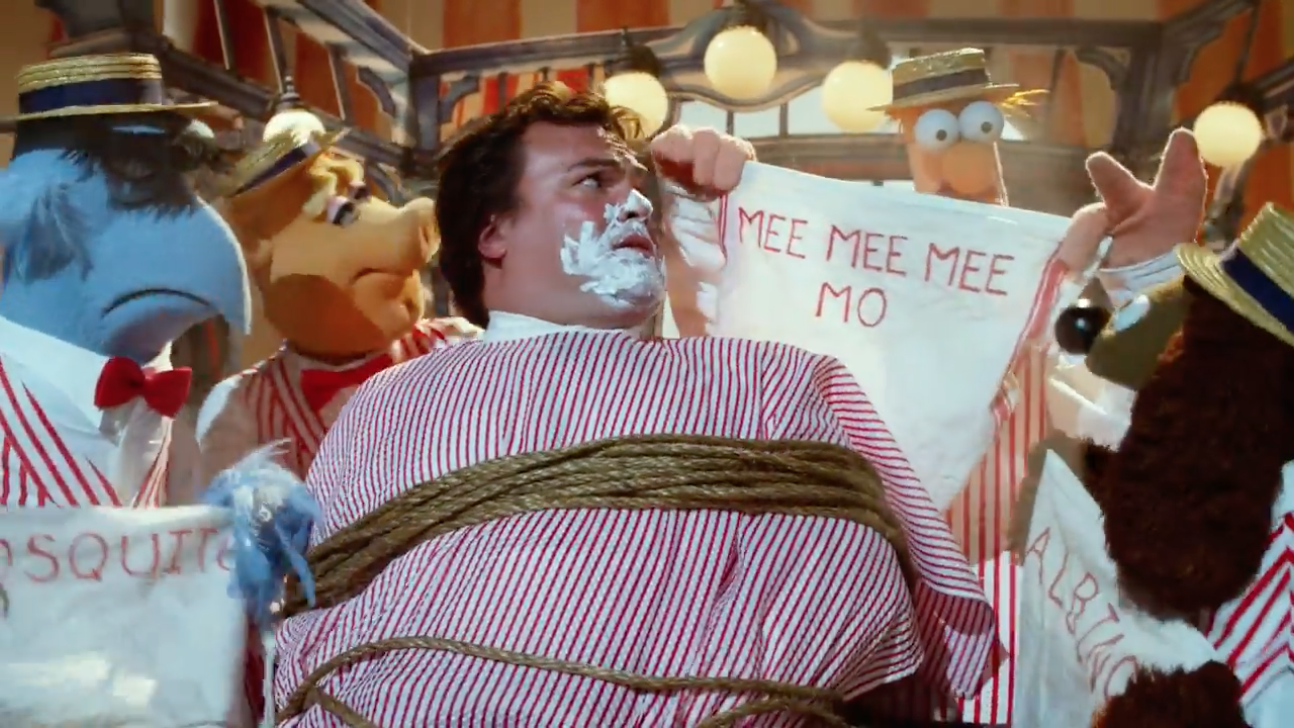 (Both these songs, by the way, are performed in abbreviated versions in the film’s montage of the telethon numbers, but get full, extended versions on the soundtrack. I gambled the the $1.29 each on iTunes, and it turns out I much prefer the full-length editions. “Teen Spirit” removes all of the Jack Black, thus emphasizing the barbershop quartet harmonies, and “Cluck You” enjoyably pushes its simple punchline to a full two minutes, twenty-eight seconds.)
It’s a curious blend of Muppet Show technique with Muppet Movie expectations, culminating in a cast-wide rendition of “Rainbow Connection”, perhaps the Muppets’ most famous contribution to pop culture. Read the rest of this entry »
THE FELT-LINED COUNTDOWN: Muppets Most Wanted
The second of the pure-Disney release Muppet films and the most recent theatrical Muppet Movie, we begin our peeling back of the Muppet onion with a great opening: the ending of the previous film. I’m not often a fan of “five minutes later” continuity (one of my main problems with The Incredibles 2), as it tends to mean that characters are plunged back into the waters of conflict after we’ve just reached some sort of catharsis and reconciliation, even if it was actually several years ago from the audience’s perspective. However, it’s hard not to be charmed by the audacity of beginning a film with fireworks and a “The End” card. (Especially as that’s the opening of my own unfinished screenplay…)
The film then charges into choppy waters. The very first scene is promising, in that it establishes that the end of the previous movie is the end of the filming of that movie, tapping into a conceit that is long rumored to be a key aspect of Muppet Movie-making: that all of the Muppet movies after The Muppet Movie are the movies that the Muppets made as part of their deal with Lew Grade. (Listen to film nerd and Muppet fan Griffin Newman speak on this as a guest on the No Excuses podcast.) The Muppet Movie is, after all, a screening of the Muppets watching “The Muppet Movie”, an “approximately how it happened” biopic of how The Muppets really got started. It’s an A Star Is Born narrative with the Muppets playing themselves, and most of the rest of the films are supposed to be films of the Muppets continuing to play the Muppets in various scenarios. The Great Muppet Caper perhaps does this metafiction best, with The Muppets Take Manhattan blurring the line the worst, but providing an explanation as to how Kermit and Piggy get married at the end of that film and yet remain romantically separated for the rest of their careers.
So this first scene starts in line with the metafictional expectations of certain Muppet fans — so far, so strong — but then immediately wrong-foots itself by launching into a backlot song-and-dance number. The song is moderately catchy but a little flat. I found the Hollywood backlot stuff confusing, as I didn’t click with the decision the grips and wardrobe people performing in a vaguely ’40s atmosphere, which serves as homage, but adds little else. The main problem is that the dancing line of the main Muppet cast is stiff, and lacks depth or interesting choreography, and the stilted Singing in the Rain antics of the humans does not make up for it, especially as the action is so obviously segregated on two planes. The film satire montage is fun, but both it and the retro heart of dance number seem to essentially misjudge the audience.
Thank goodness for the insane cut to Constantine: The World’s Most Dangerous Frog.
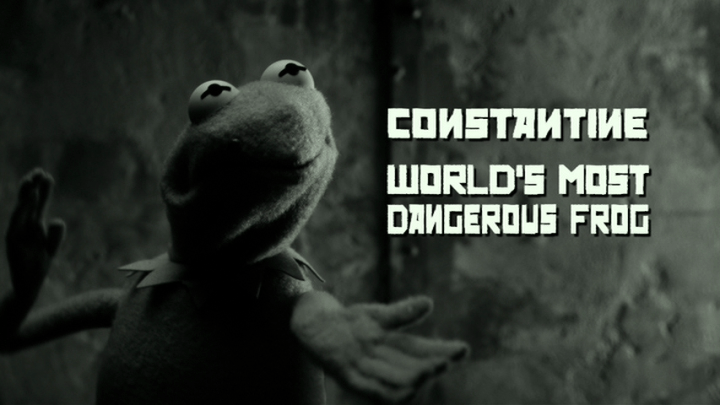
“It’s like ’83 all over again. Out of the shadows and, ‘All right, squire?
Trust me.’ and gone before you know it. Christ, that was a laugh…”
 RSS feed
 smartovercoat.com