Does Whatever A Spider Can
I should be strong, but the culture of self-actualization says otherwise. Be true to yourself, it says, be at peace with who you are. Old world thinking instead claims that through will power we shape our existence. Instead of making peace, we used to struggle. “All progress is made by unreasonable men,” quoth Bernard Shaw. That sort of thing. But, instead, I am soft and the product of my culture (see! that in and of itself is a self-actualizing statement), and find it difficult to rail against the dying of the… something. Pride, perhaps.
 What is all this musing in aid of? Arachnophobia. I have found myself, as time passes, being increasingly okay with my squeamishness towards chitinous scrabbly things. I am no longer embarrassed about it. I don’t need to display a show of strength and fortitude, I don’t need to be macho. Instead I can shriek and cringe and shudder at the thought or presence of something with far too many legs and an alien physiology. And I can lash out in revulsion at their fear-inducing structure and squash the hell out of them with impunity, despite the fact that the collapse of their exoskeleton and the subsequent liquidation of their organs does little to make the revulsion go away.
However, this acceptance has also allowed the fears and feelings associated with coming into contact with such arthropods to magnify. By allowing them to occur, by not repressing them, they now hold full sway. Which becomes a problem when, as happened to me last week, one is in the middle of a long stretch of highway and suddenly notices a spider walking merrily across the inside on the windshield. Such a situation causes instant fear-based tension, revealing itself in symptoms that would look to any of my fellow highway travelers like a particularly rigid case of white-knuckled white line fever. Because, I needed to do three things simultaneously: 1) Not be overcome with a violent case of twitches and shudders, all of which would require me releasing my hands from the steering wheel, 2) finding an exit, quickly, and 3) following the movement of the spider so that when I finally pulled off the highway I could kill it with extreme prejudice. It’s difficult to focus on a small, dark creature on the inside surface of a transparent object you’re also supposed to be looking through, and so number two was difficult, but not nearly as difficult as number one, because the more I focused on the spider, the mode massive shudders kept coursing with pounding tides up my spinal column.
 Once on the side of the road, I discovered that due to the sloped glass of the windshield, I had difficulty squashing the little bugger, and so tried to transport him from the car so that I could jump up on down on him once he was on the large, flat expanse on non-sloped pavement my car was pulled over next to. But in removing him from the car, there was a moment when I lost track of him. He was no longer on the windshield, and not longer on the object with which I was removing him from the car, which meant he was either safely outside or somewhere on the floor of the car, or someplace generally hidden away. I squished another passing spider that had nothing to do with the proceeding, simply out of frustrated retribution. But this has not prevented me from interpreting every stray brush of hair, fabric, or whatever inside my car as, “AAAAAHHH! AAAAHHH!! THE SPIDER”S BACK! AND IT’S ON ME!!!” My own little pathetic personal version of post-traumatic stress disorder.
In attempting to allay this syndrome, I was listening to Phil Jupitus’ excellent stand-up bit on spiders from his Quadrophobia album, but all his talk of spiders and wriggling legs and the like just made the onset of the Phantom Arachnid (Not Insect) Contact attacks more frequent and more vivid. I think it’s time to go back to steely resolve, and none of this twenty-first century “be true to your pansy instincts” nonsense.
Camera Lucidity
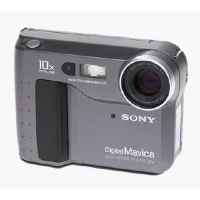 The picture to the left is that of the Sony Mavica camera. I’m in love with this camera the way I never have been with a digital camera. And why? Because it’s not especially good. It’s got little in the way of features, and the best pictures it takes are of a 0.8 megapixel resolution. And it’s the size of a late-nineties digital videocamera, the first ones that you’d see parents at weddings and graduations holding away from their bodies as they squinted at the tiny viewscreen. There was an odd zombified quality to their perambulation as they wandered about, holding the camera with stiff arms away from them and trying to frame whatever it was they were trying to capture without jiggling the whole device. One loses the fine motor control of stability when one is relying on that many muscle groups.
However, this camera takes pictures and saves them immediately to a floppy diskette. What a great idea! The school library at which I’m currently interning has two of the little buggers in their A/V closet, and my mind is blown with the possibilities! No more messing with cords or adapters or mini-USBs or flash cards… pop the disk into the computer and post the images on the web or paste them into your word processing document. Boom. Done. What a great thing to give middle schoolers who are writing a class newspaper. It may run about $150, but it doesn’t feel like a big deal because you can’t get great pictures from it! It’s so hard for me to take pictures because I’m precious about features and settings and composition and light and shutter speed and blah, blah, blah. But with a camera like this, a camera that saves images to something as cheap and as notoriously unreliable as a floppy, well, taking pictures with a camera like that is easy, because one can’t take it seriously.
My advisor loves visuals in the portfolio reports that come out of the practicum/intern process, so I dutifully took a couple of snaps of a lecture aid I created and a poster for National Drop Everything And Read Day that I whipped up. Bang, they were on the floppy disk and ready to be exported for presentation. I dropped the diskette in my pocket…
…and it wasn’t until three hours later when I got home that I remembered that I own a Mac, and I haven’t had a floppy disk drive since 1999. So while I’m still in love with the Sony Mavica, it’s doubtful that I’ll be picking one up any time soon.
Taking the ‘Art’ out of ‘Cathartic’
Driving home from work yesterday I was listening to All Things Considered, and I stumbled upon a story that was steering wheel-poundingly fearsome and hilarious simultaneously. A man named Hamilton Banks has, after years and years of being a lifelong opera fan, finally combined his love of music with his adoration of the principles of the Power of Positive Thinking as espoused by Norman Vincent Peale, to found an opera company where he will systematically edit all the great tragedies so that they have uplifting endings.
 That’s right, at the end of Don Giovanni, the fear of Hell and its torments will so move Don Giovanni that he will be born again in the love of Christ and marry the girl. So as not to spoil the opera, new lyrics will be written to some of Mozart’s cheerier music featured in the earlier portions of the work, including the “Peasants’ Wedding Song”.
NPR contributor Alice Furlaud is very fair with Mr. Banks and doesn’t mock his enterprise. She lays it out documentary style, and does an admirable job of not emphasizing the point that anyone in his right mind would listen to such a proposal and call him a delusional fool. She does eventually quote Ms. Linda Cabot Black of the Boston Lyric Opera Company who voices quite clearly what most of the listening audience was hopefully thinking: “Oh, yes, Hamilton Banks did approach Boston Lyric Opera and offered us a fortune to change the endings. Of course we turned him down, thought it was a silly idea. …How on Earth would Puccini and Wagner and the other great composers, what would they think about changing the endings? It would be just ludicrous.”
Mr. Banks, on the other hand, is quite convinced of the purity of his exercise. He honestly cannot conceive of an audience’s desire for catharsis, leading him to say in one breath that he loves the operas of the great masters, and then in the next that maybe “if the wonderful anti-depressant drugs we have today had been available, they’d never have written those depressing endings and maybe they’d never written the whole opera.” Great! That’s what the power of positive thinking can do! Deprive the world of Great Art! Well done, Mr. Banks for showing us the way: we need to medicate all artists out of existence!
However, if one were less inclined to be outraged and want to use the Power of Positive Thinking to find something worthwhile in this ridiculous news story, it is a marvelous example of the classic syndrome of Life Imitating Satire. Some of you may recall the episode of Jon Lovitz’s The Critic where a TV executive uses digital editing to create new happy endings for films like Casablanca. That was done as a joke, as the sort of idea of which only the most boneheaded and inartistic individual could conceive. But now we know that such an individual isn’t just the fanciful, fictional comedic extreme of someone’s imagination! America strikes again and proves that not only can someone this outrageous be real, but he can also be incredibly successful! USA! USA! Providing the world with self-deluded, charismatic, ignorant bizarro-humans for over two hundred years!
 RSS feed
 smartovercoat.com